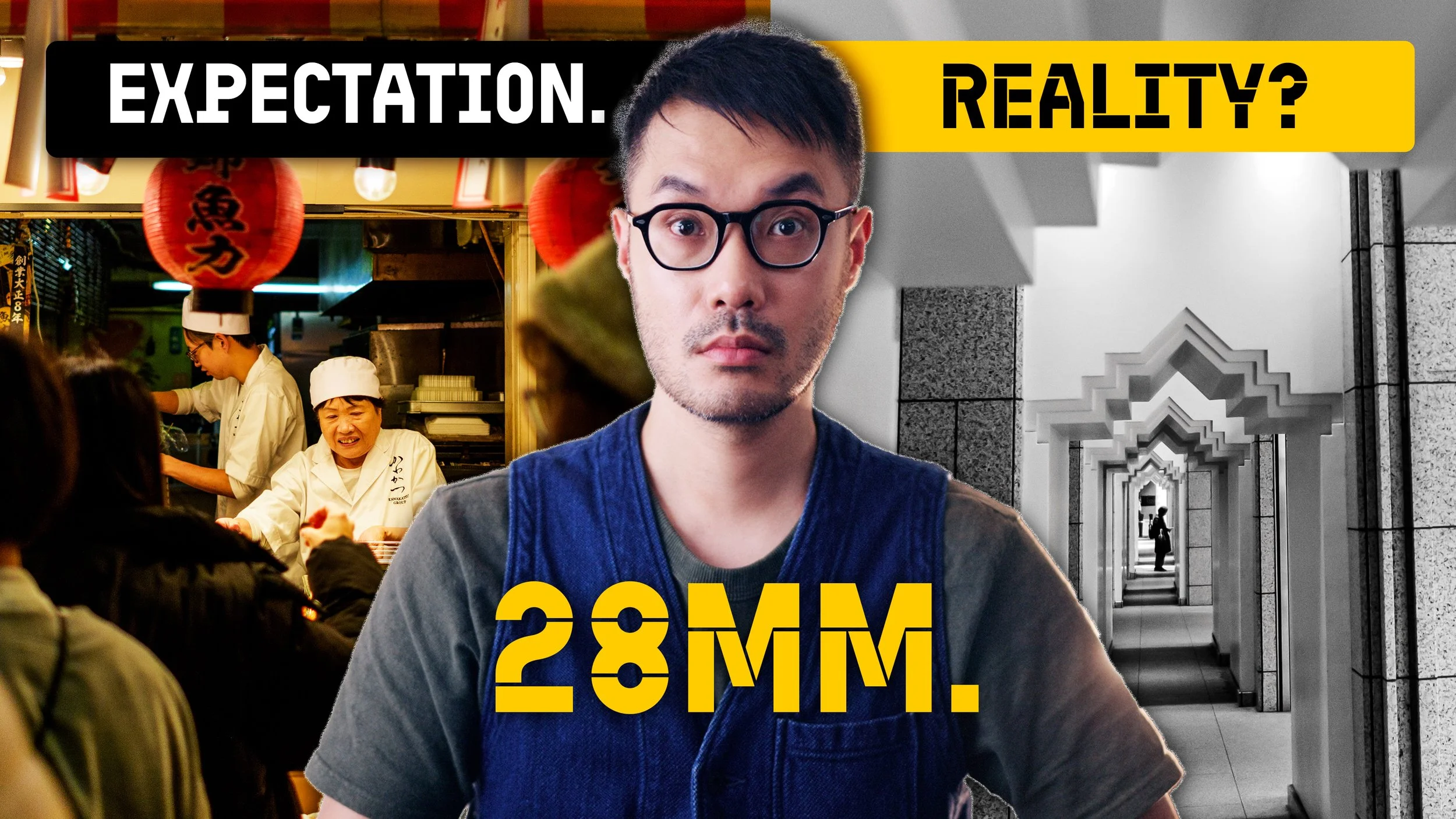
Why Everyone* Struggles with 28mm (at first)
All these photos were taken by me on 28 mm.
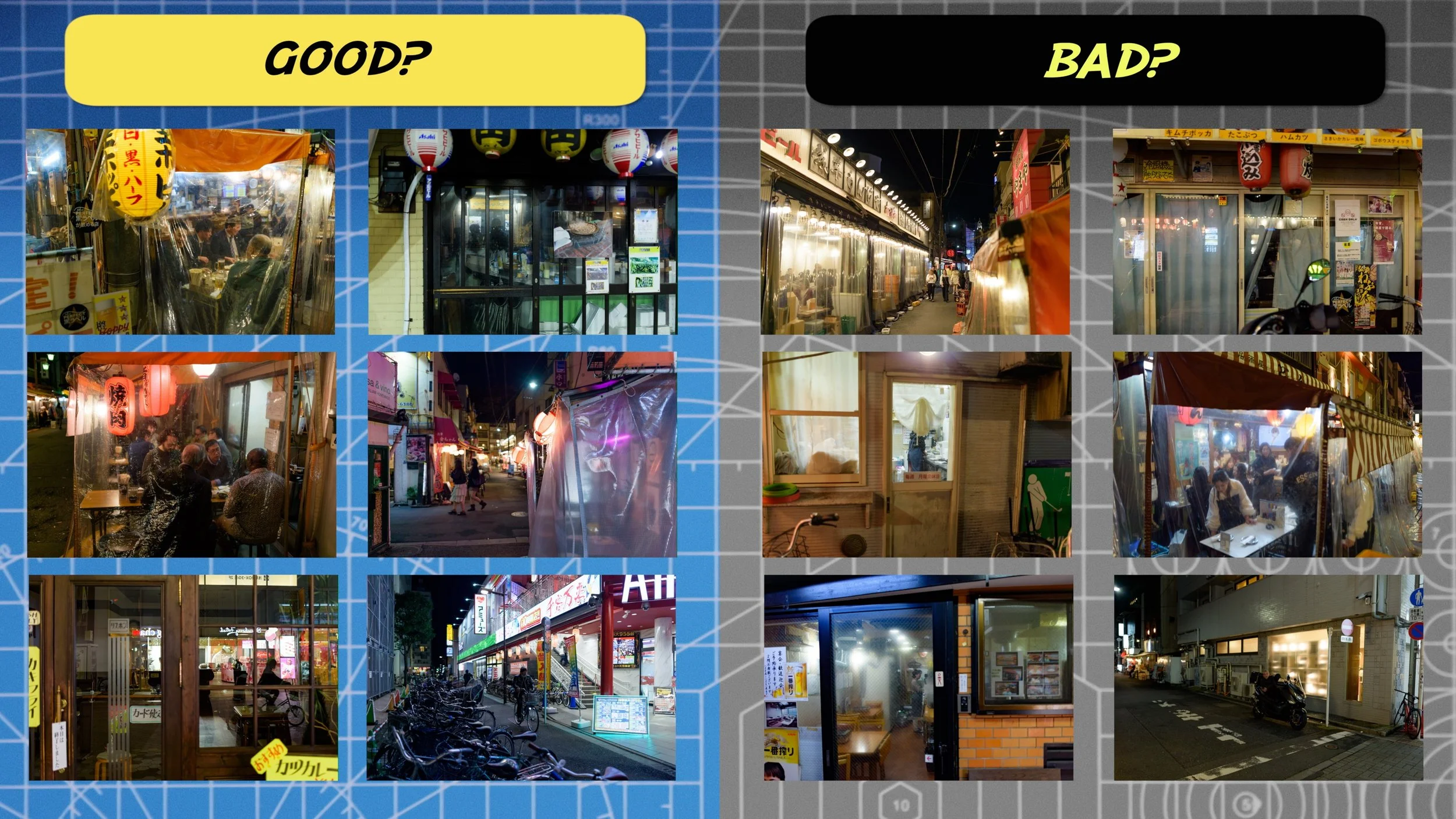
Half I like, half I don't.
Truth is I don't know why?
Some of these were taken overseas, others back at home. It might be the gear?
I tried so many 28mm lenses, both manual focus and autofocus.
Here's what I do know: it's not easy using 28 mm.
I’ve found 5 techniques to make it more manageable?
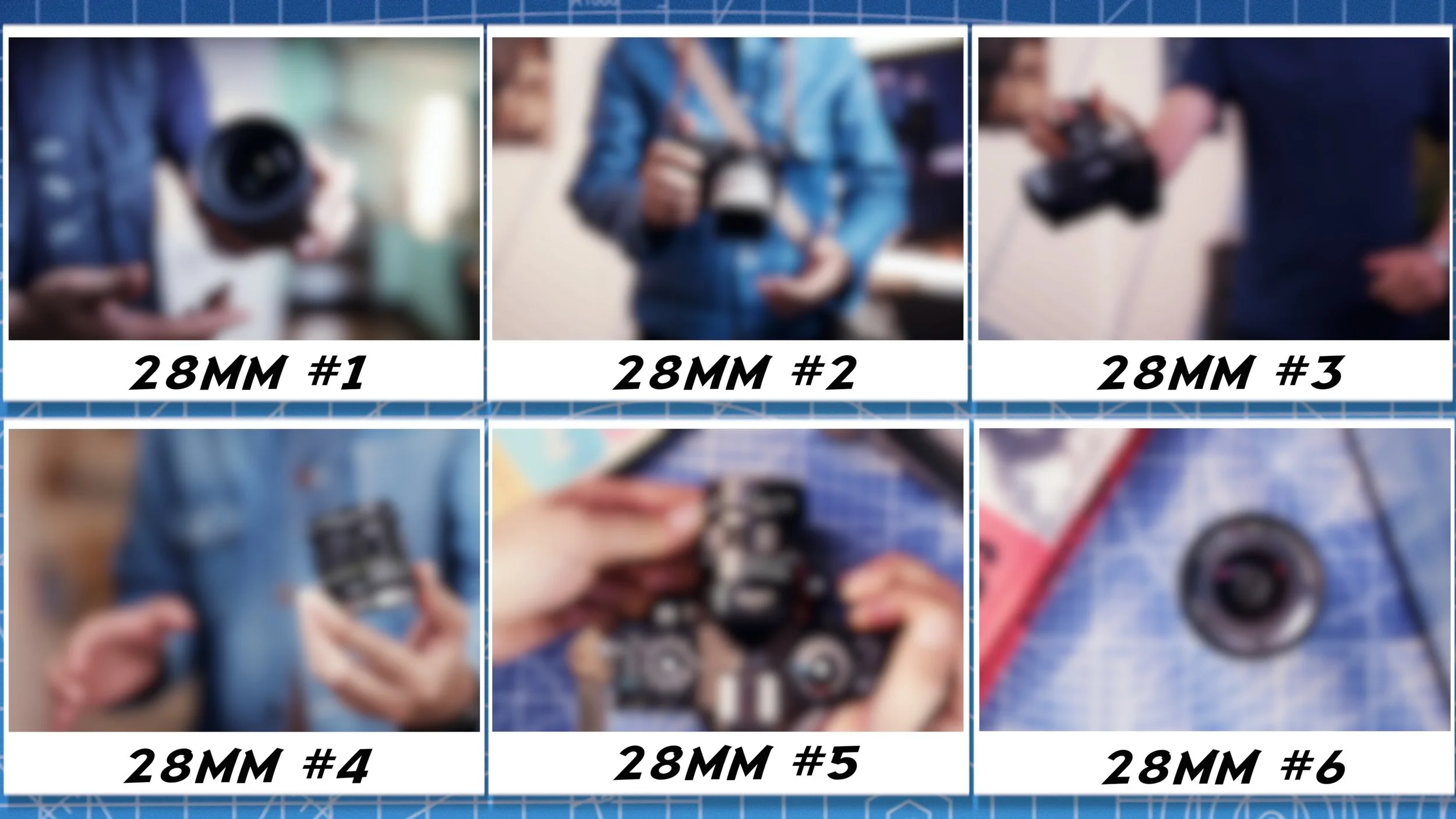
This is the pilot episode of a new Lens Lab series.
Today, I'll be talking through my own 28mm photos and my favourite 28mm lenses. The elephant in the room is I'm not a pro. 28 mm is hard, but it's all about growth. In fact, I'd love to learn from all your 28 mm photos.
At the end of this blog there’s a link for you to upload your 28mm frames - with a twist:
Frame 1: a 28mm phot you’re NOT happy with, but learnt something from
Frame 2: a 28mm frame you ARE happy with after applying the lesson learnt from Frame 1.
What I’ve learnt about 28mm? 5 techniques, the first of which is:
I. Arm’s Length Away.
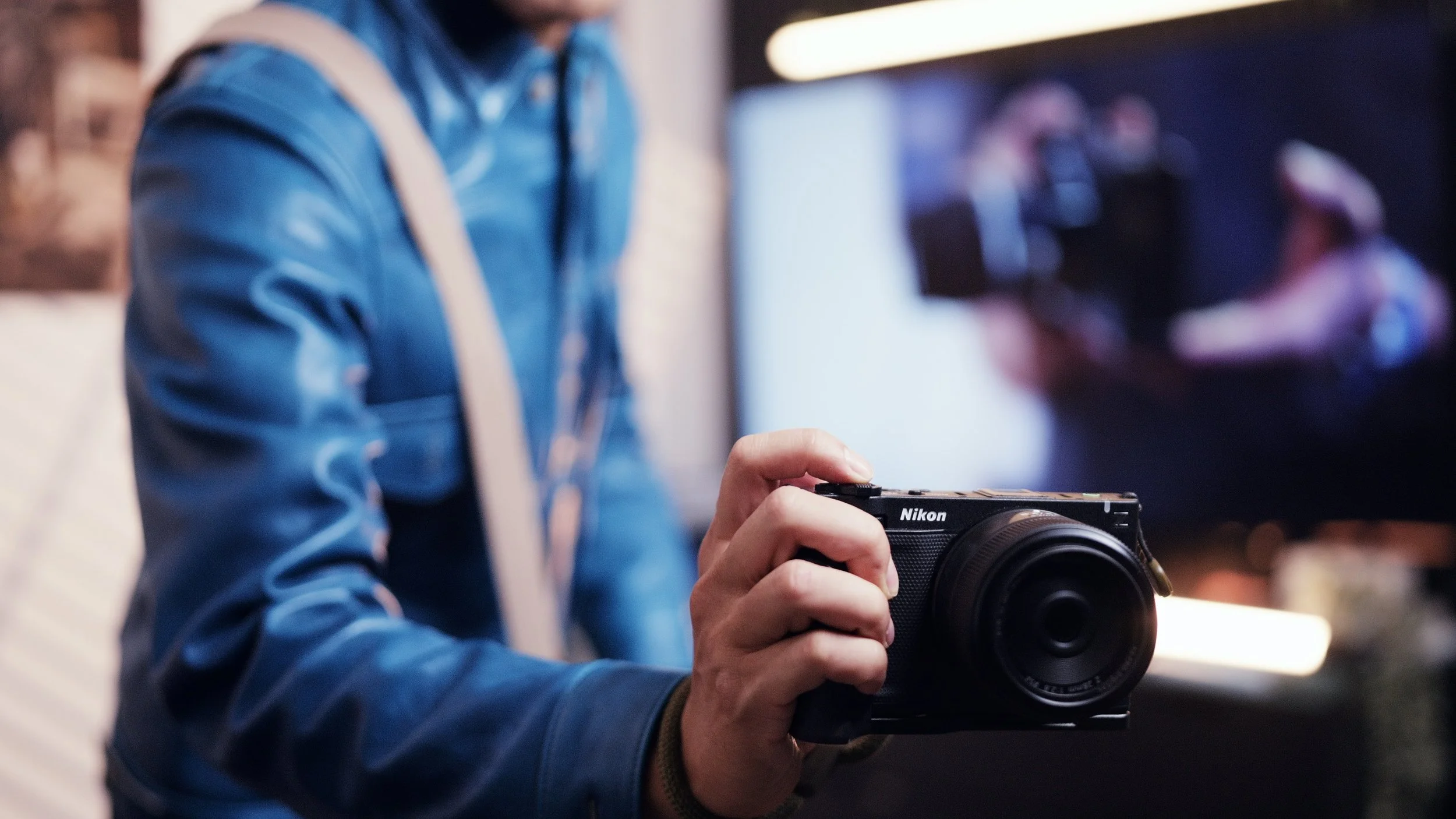
28 mm is a delicate dance.
You need to get into that Goldilocks zone between 1 to 2 arms’ lengths away.
Any closer than that, you can fill the frame, but there's perspective distortion. Things look a little less natural.
Asakusa at night feels natural.
A tourist trap by day, but the beautiful temple, but come night time, the locals come out to eat at the bars, and restaurants. Placards and dividers put up in and around the restaurants. It should be perfect for a wider lens like 28 mm.
But on 28 mm, more often than not, Frame 1 is the outcome:
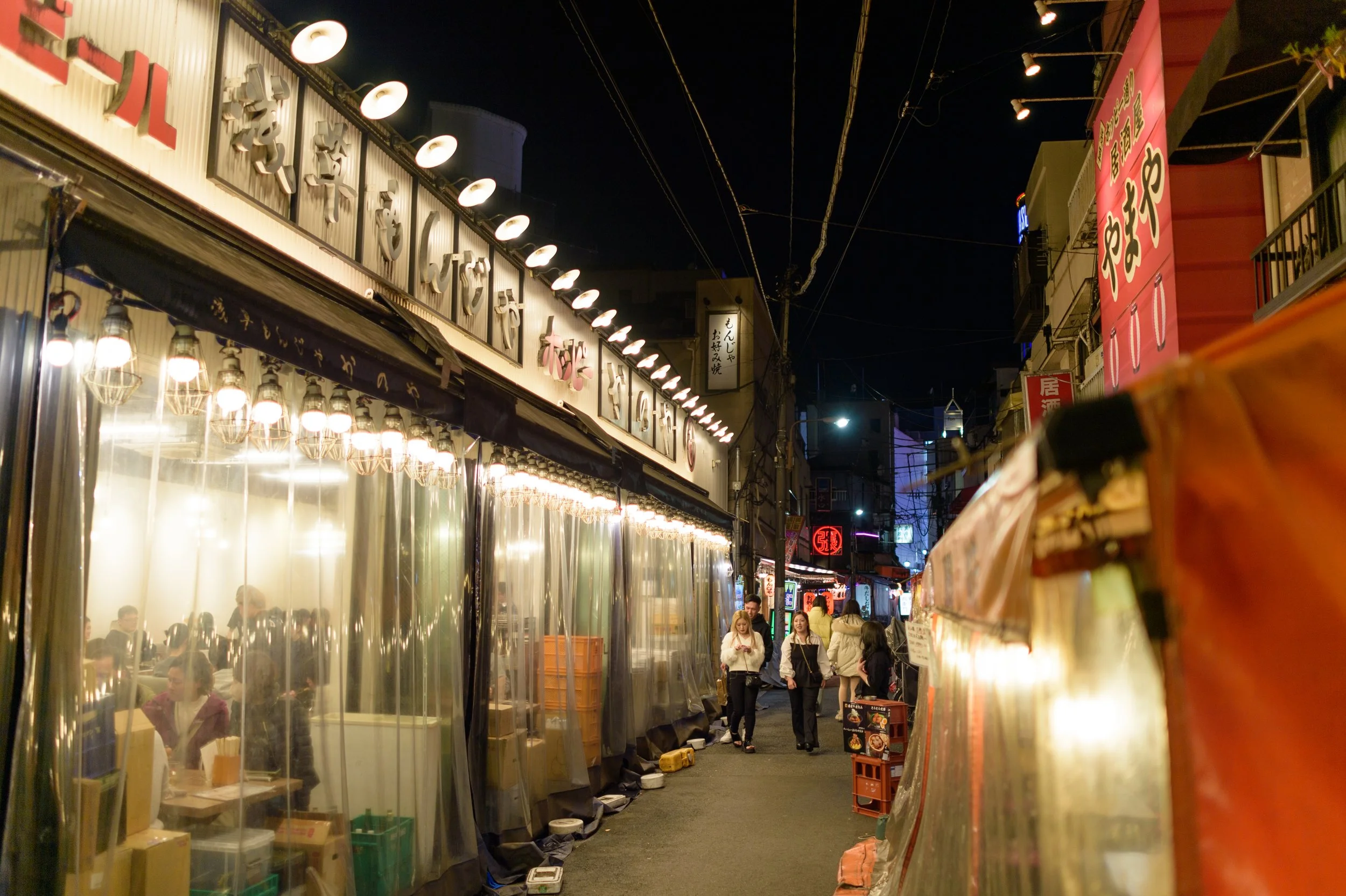
Frame 1: Asakusa, Tokyo. It’s not great, I’m too far away, taken on 28mm #1
There's leading lines, lots of lights. There are all of these pedestrians that are just a little too far away.
If I was standing a bit closer, then this composition would have worked. I would have used all these leading lines to my advantage. I wasn't in that zone.
There's a way to make this work, and lean more on the geometry (more on that technique later). But the next shot, it did work?
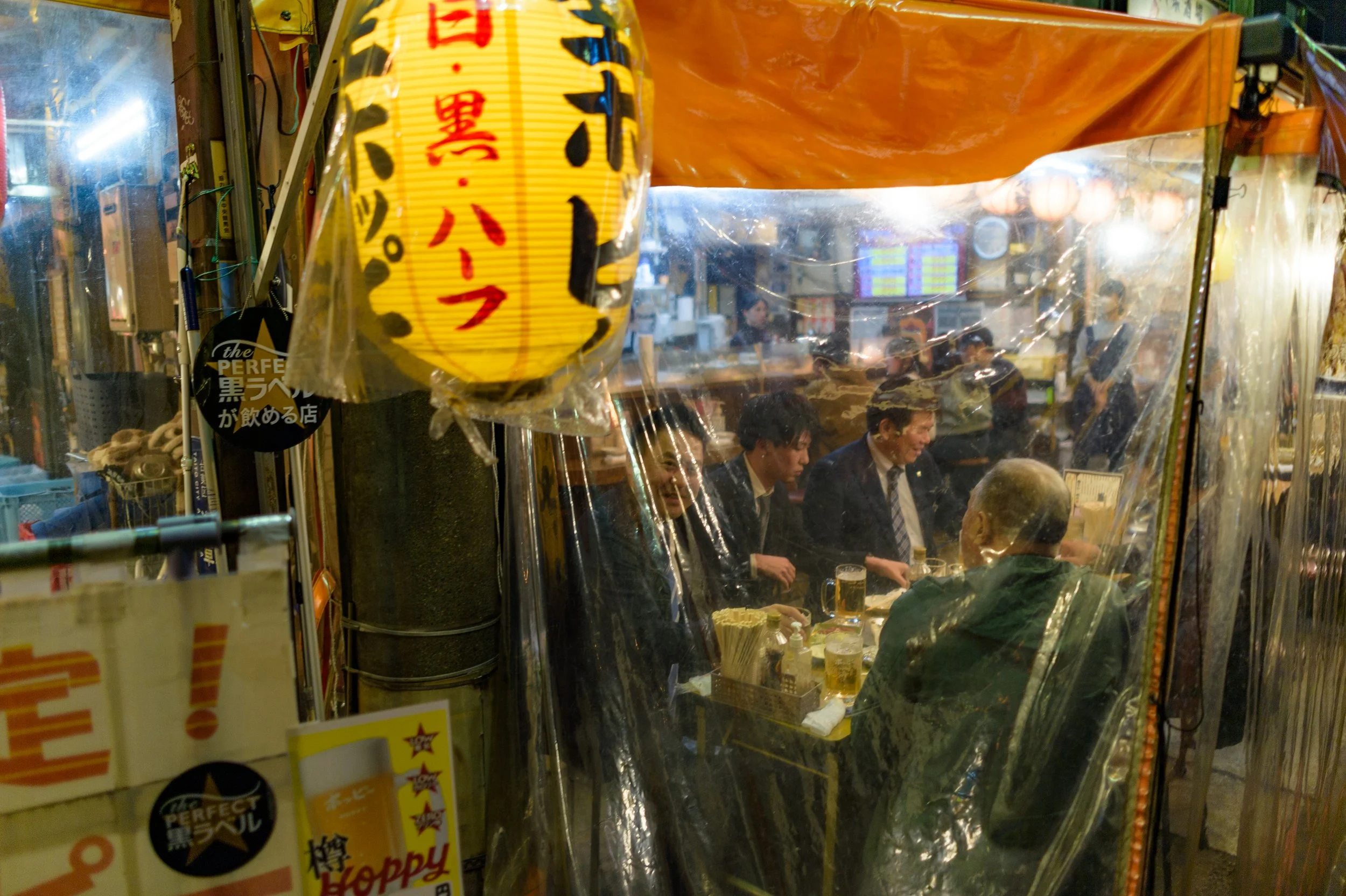
Frame 2: Asakusa, Tokyo. Closer, and (a bit) better, taken on 28mm #1.
This shot is in that Goldilocks zone, you can see this lantern to anchor the composition. The man that I focussed on is looking into the lens. It's not so close that the people's faces look distorted however.
The proportions still look fine, and it's a little bit out of focus towards the edge of the frame? But on 28mm there’s just not that much separation, it’s hard to use bokeh as a visual element.
What you can use?
II. Mind the Gaps
When you can't get into that Goldilocks zone? If faces don't dominate the frame then you have to use spaces to do the heavy lifting.
But in the next frame it didn’t really work - the space wasn’t that interesting.
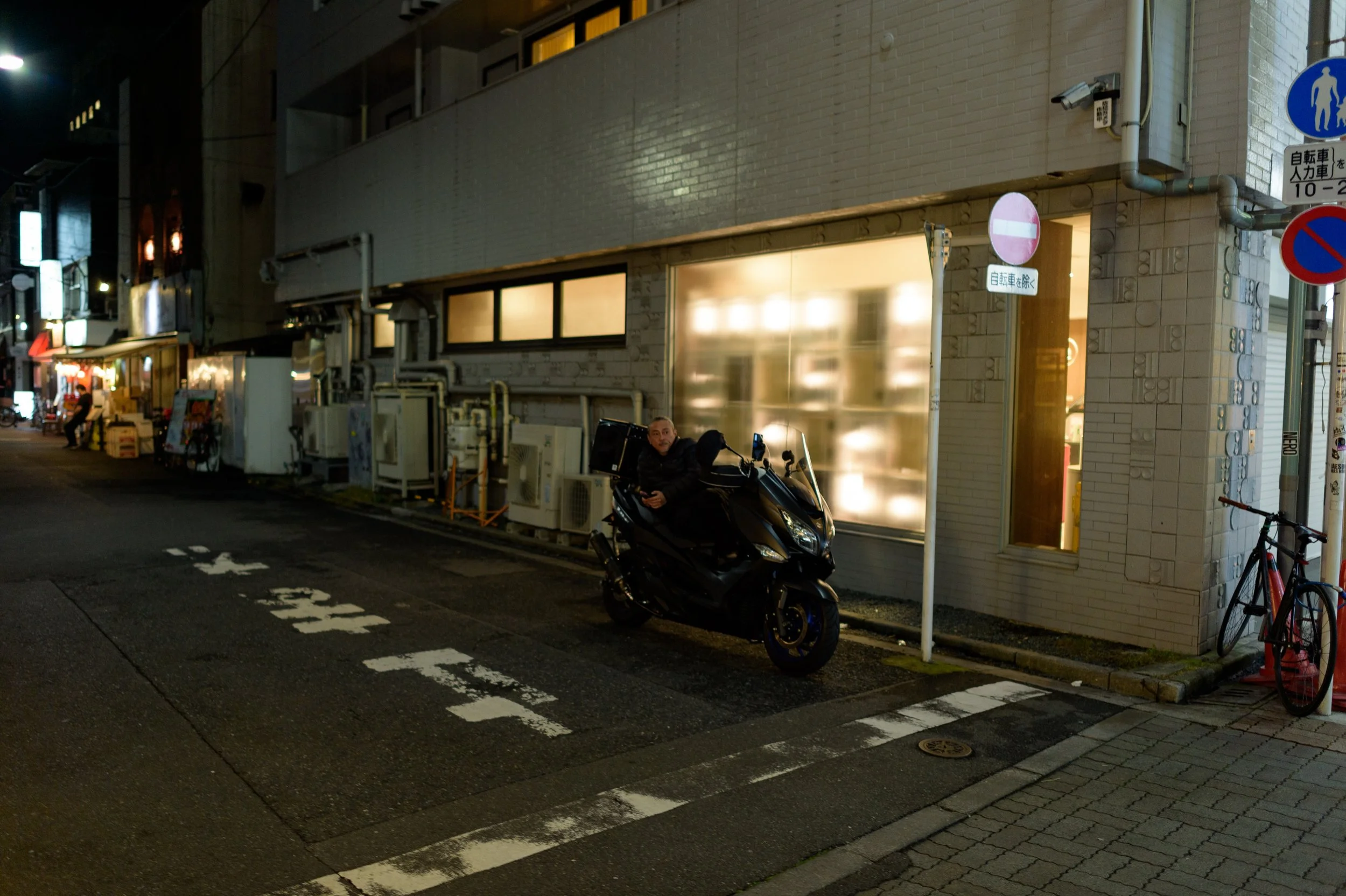
Frame 3: Asakusa, Tokyo. Too much space? Taken on 28mm #1.
It's a man lazing on a very precariously balanced motorbike, not something you see every day.
There wasn't much happening in and around the frame? Wasn't close enough to focus on the face, and the space around him wasn't that interesting.
But on the next frame even though the cyclist is around the same distance away from me as that man lazing on the motorbike, it worked better?
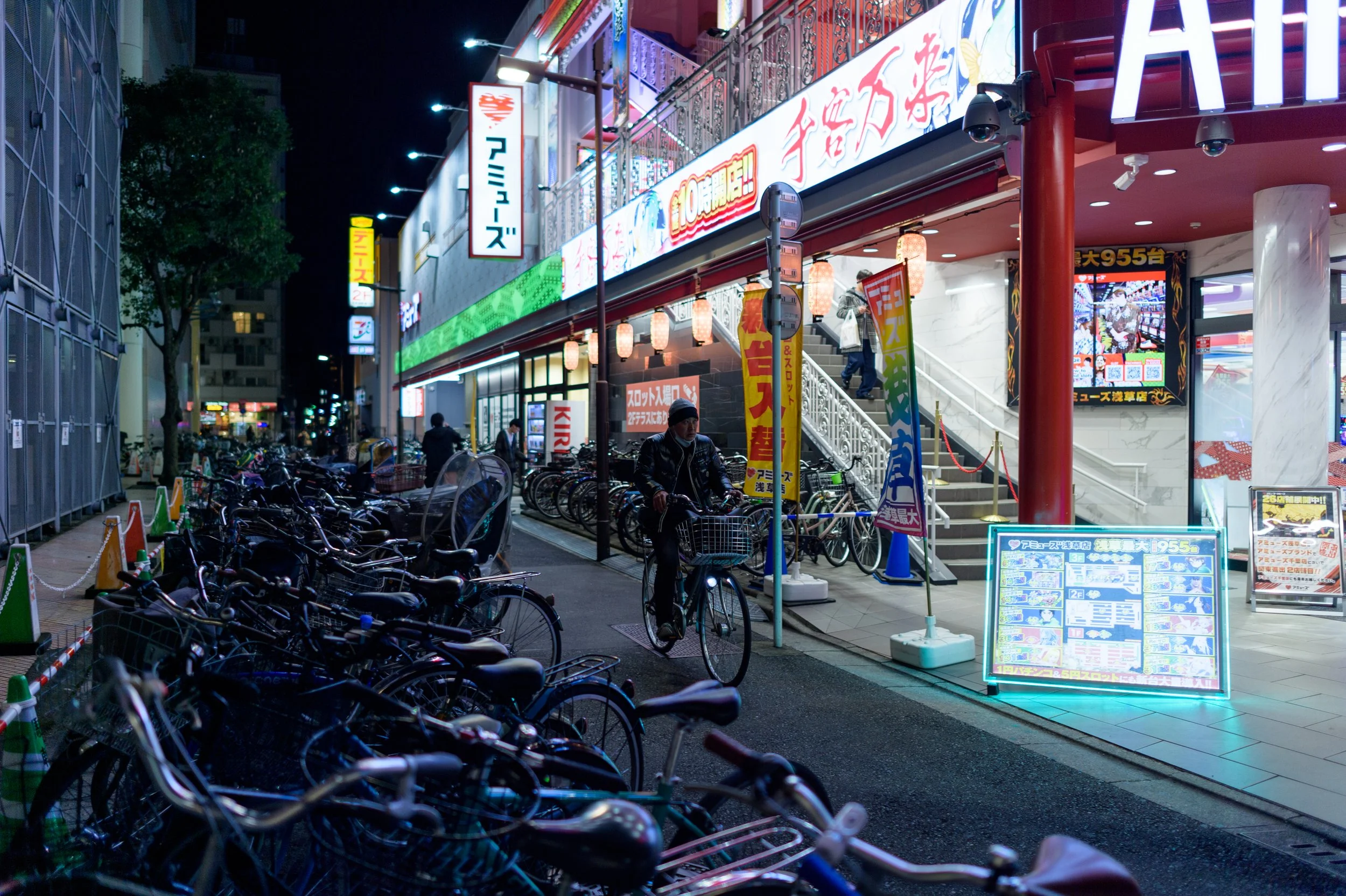
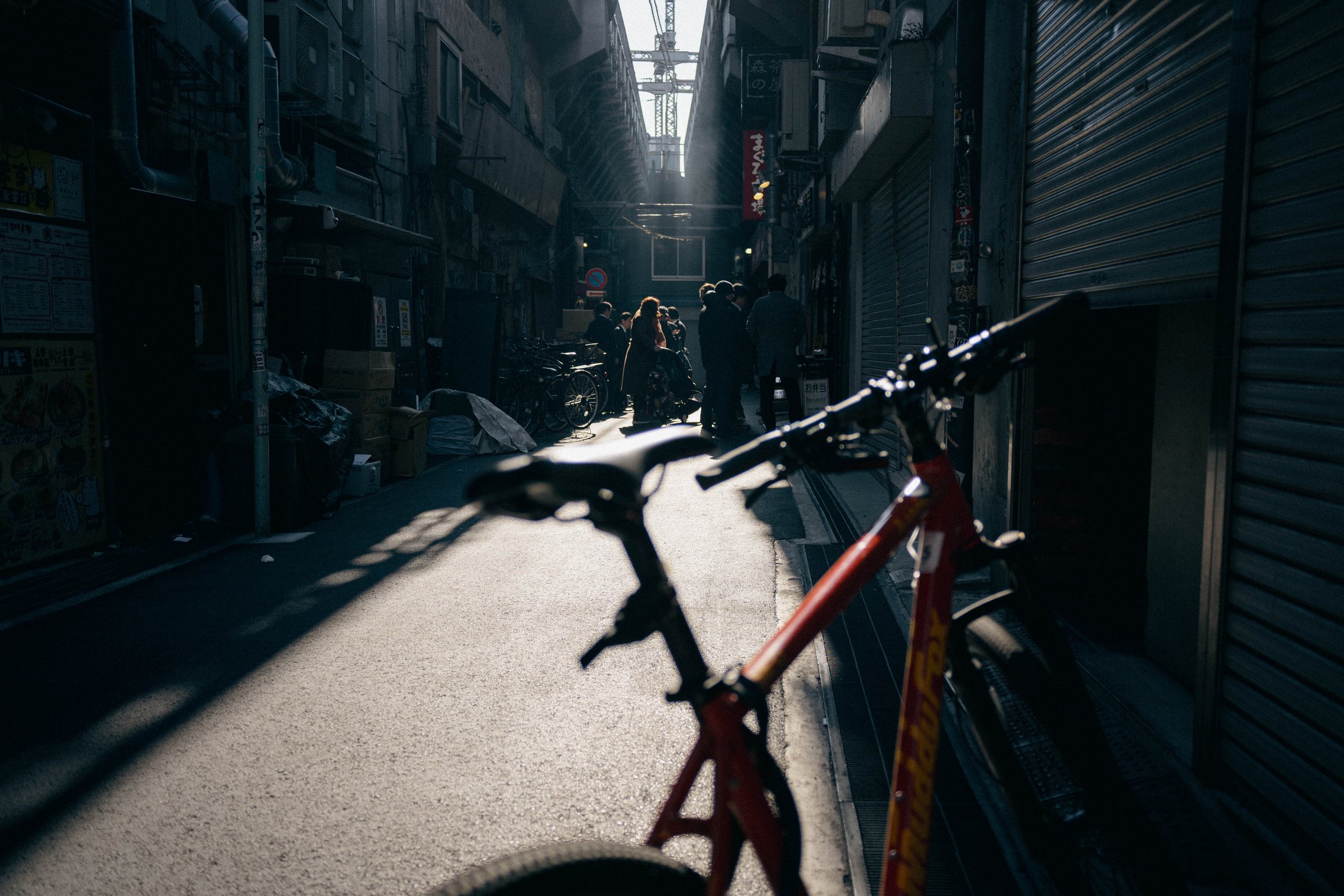
Frame 4: Asakusa, Tokyo. The space is more interesting, taken on 28mm #1
You can see a bit of his face, but if you don't have a face with 28 mm, you can focus on the space. You can see there's so many bikes, there's leading lines, a sense of geometry.
It isn't great, but because of the space, and not the face, it works.
But this technique is not without its risks.
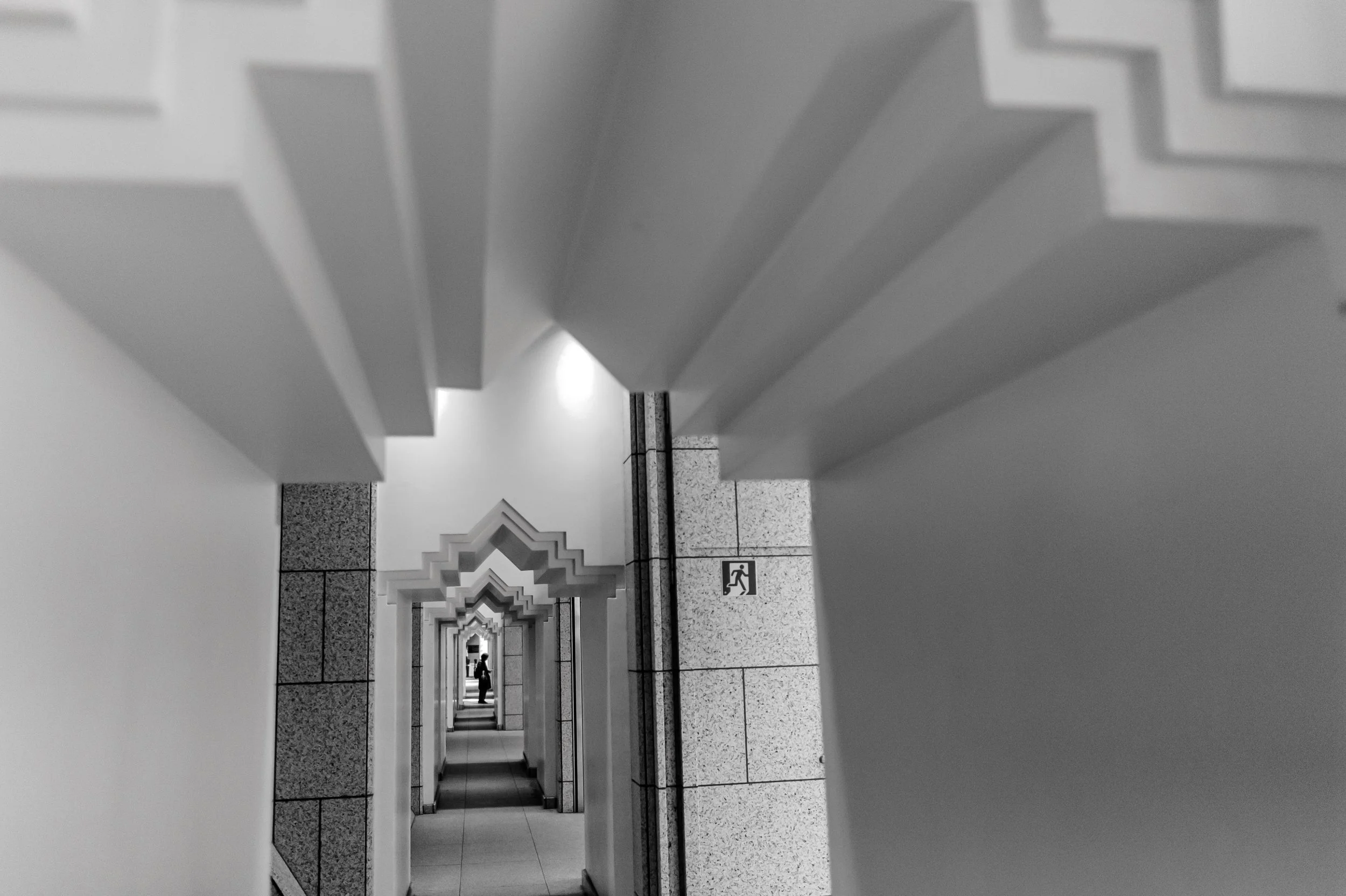
Frame 5: Kyoto. Way too much space, taken on 28mm #1
That’s the problem with this minimalist shot in Kyoto.
It really leans into the geometry. Cascading archways, all guiding your eye to this tiny pedestrian. Interesting shot, geometrically and aesthetically, but I don't remember much of that moment, or, indeed, that person.
It's not about the face, it's about the space.
That's the same problem I have with this next shot in Osaka.
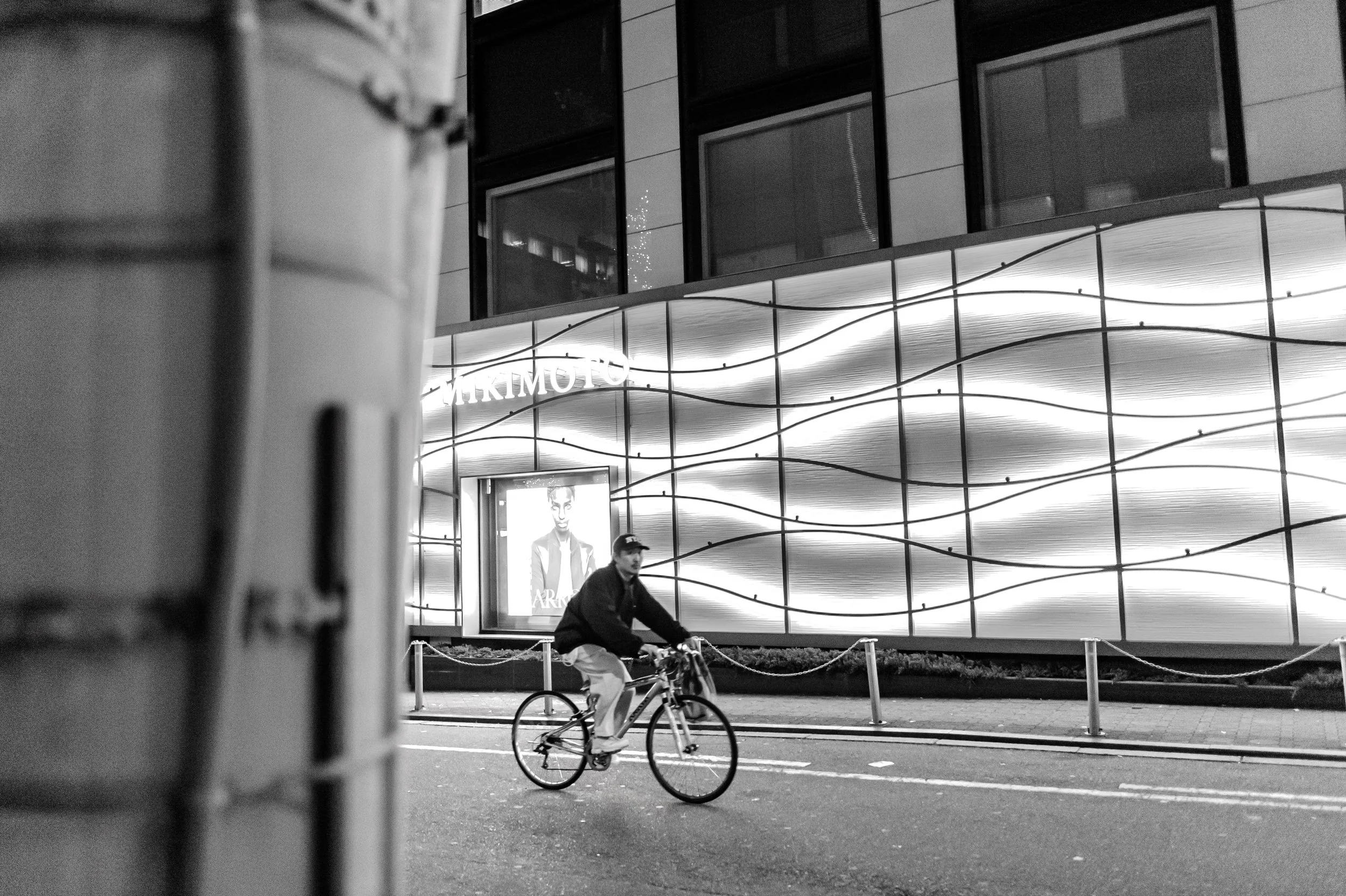
Frame 6: Osaka. Plenty of geometry, not enough story? Taken on 28mm #1.
Lots of geometry in the foreground. These wavy lines of the billboard, these windows, rule of thirds. It ticks every box (in theory). You can see a bit more of the cyclist’s face (I think they’re surprised to see me).
I'm not sure about the emotion (or story) it's trying to convey?
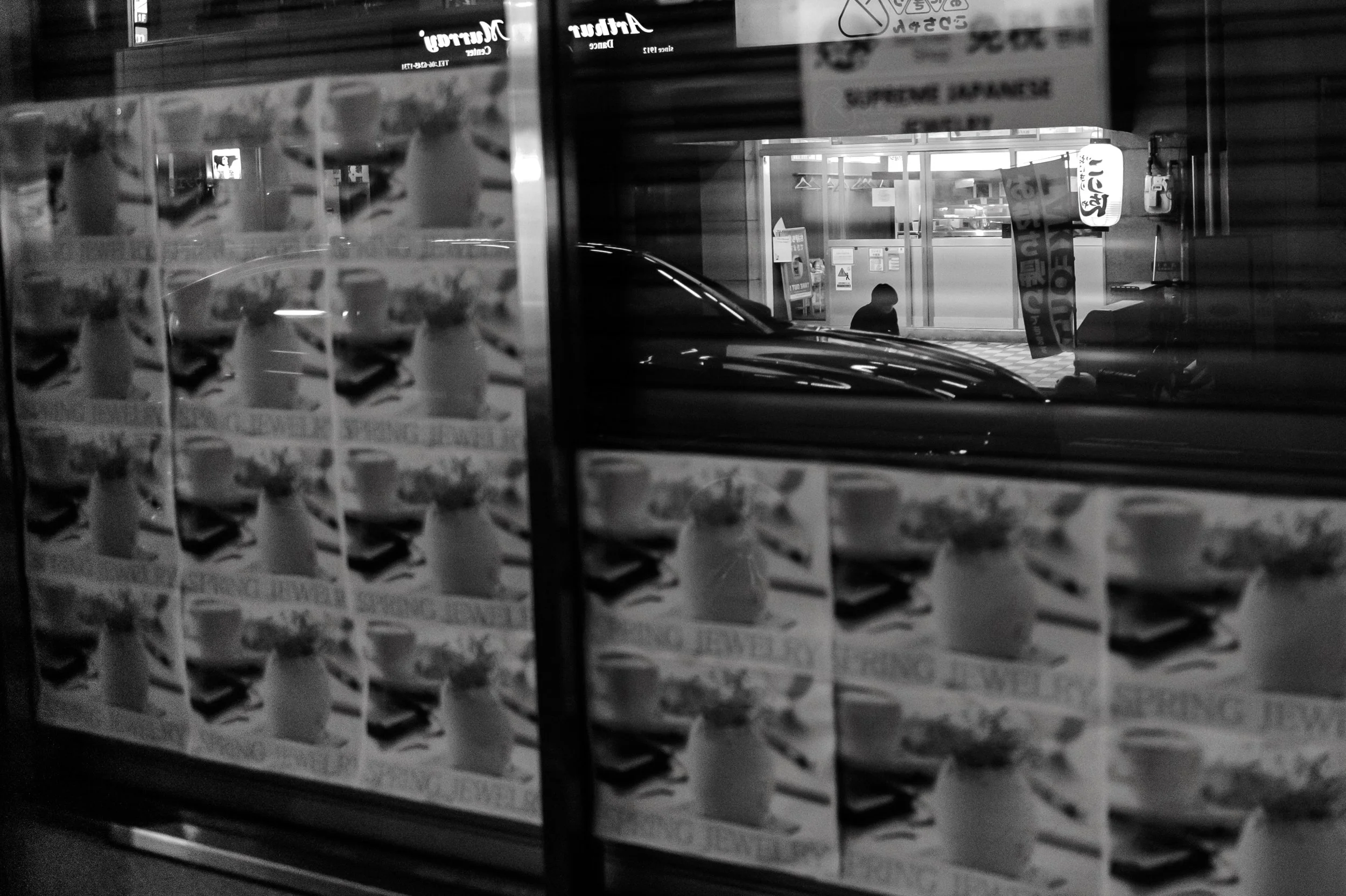
Frame 7: Osaka. Silhouettes, geometry - where’s the story? Taken on 28mm #1
This next shot, also in Osaka, you see a silhouette here, outlined against this shiny reflective car. There are interesting visual elements, a little lantern here, these repeating posters there. They act as a nice subframe that draws your attention to this silhouette.
What is it saying though? It's about the space, not the face.
This “problem” is especially evident in this last shot I took in Osaka.
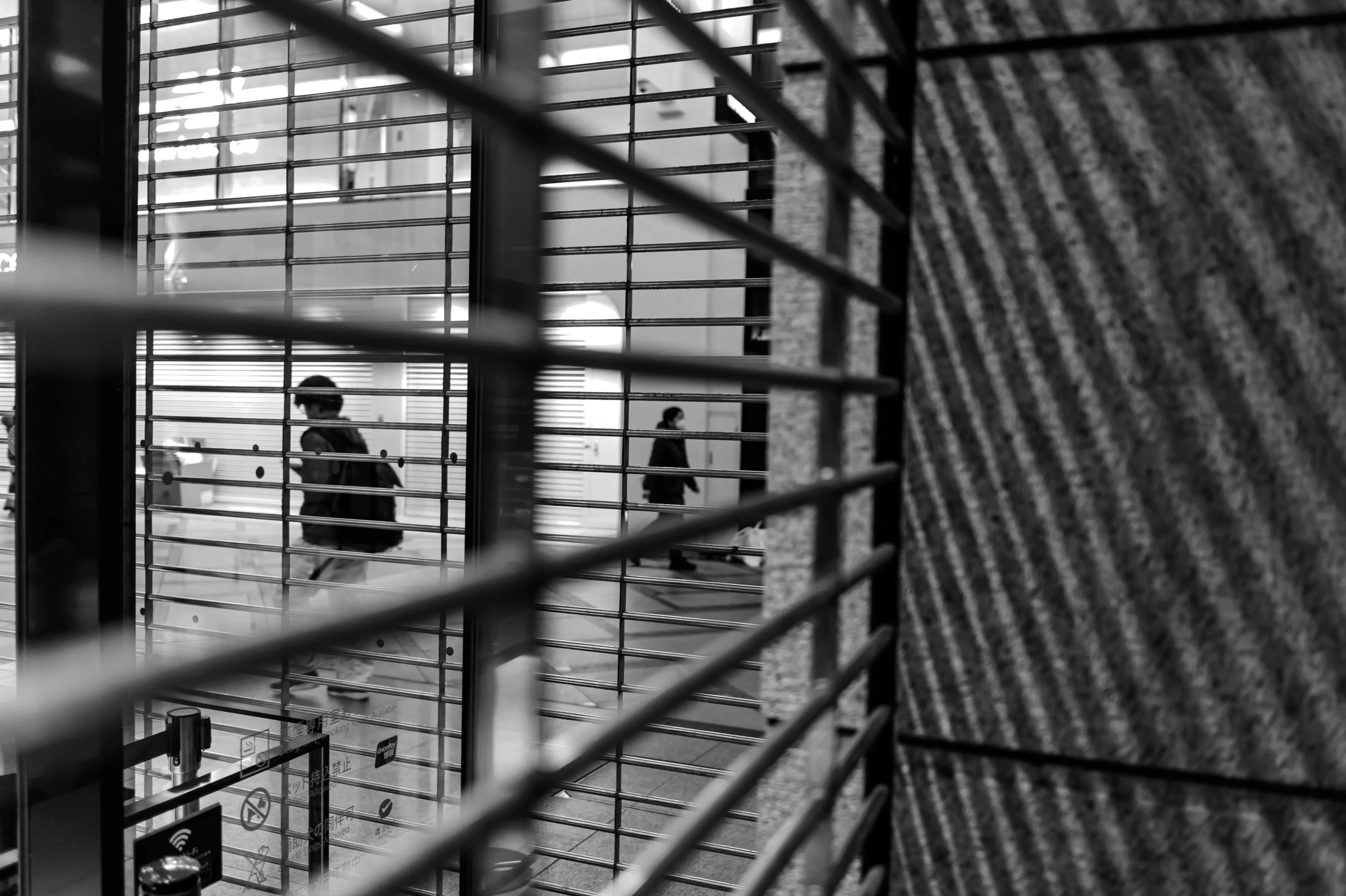
Frame 8: Osaka. Plenty of geometry, can spaces alone be the story? Taken on 28mm #1
I like the shot, when I took it, I still like it now. All of these crisscrossing geometric lines.
Is it about these people? Is it about the place? It’s a bit too abstract to have a clear narrative.
The main reason these shots have fallen a bit flat is that Osaka and Kyoto, where I got these shots, are crowded cities full of life.
In search of spaces, I went out of my way to find these minimalist abstract frames. It's not the authentic experience that I depicted.
It's hard to remember a space when those faces are lost in the shuffle.
At this point of the blog, if you're not impressed by any of my 28mm shots? I totally agree with you.
These are my best 28mm frames, cherrypicked from 1000s of even worse 28mm frames.
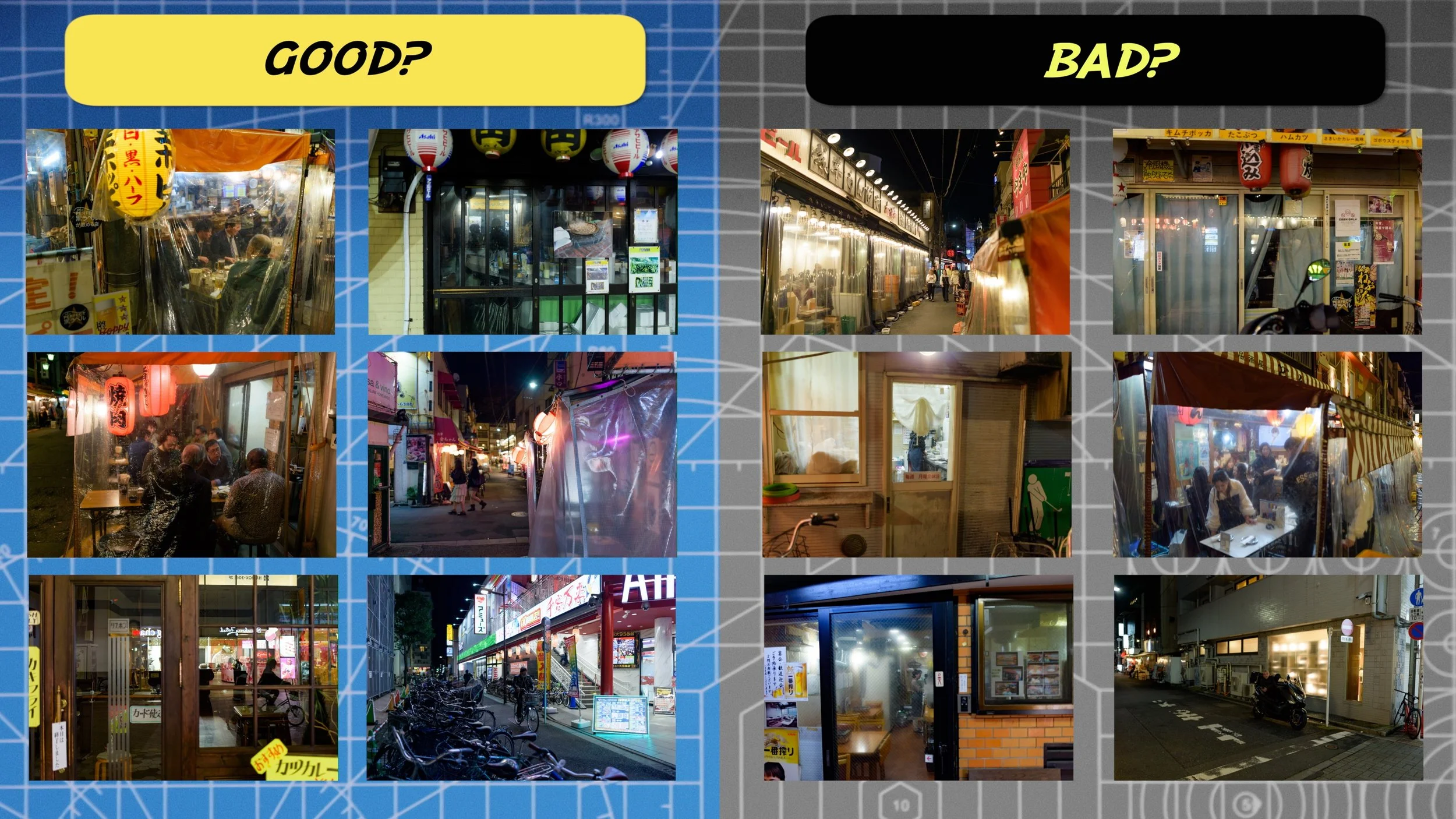
In future episodes, this is where I’d like to feature your photos?
Not just your best work with that week's focal length, but also one you're not happy with (and how you figured out the difference?).
If you’re interested fill in the form at the bottom of this post.
III. Find Your Level
28mm lenses (and wider) can get distorted if your camera is tilted, even just a little:
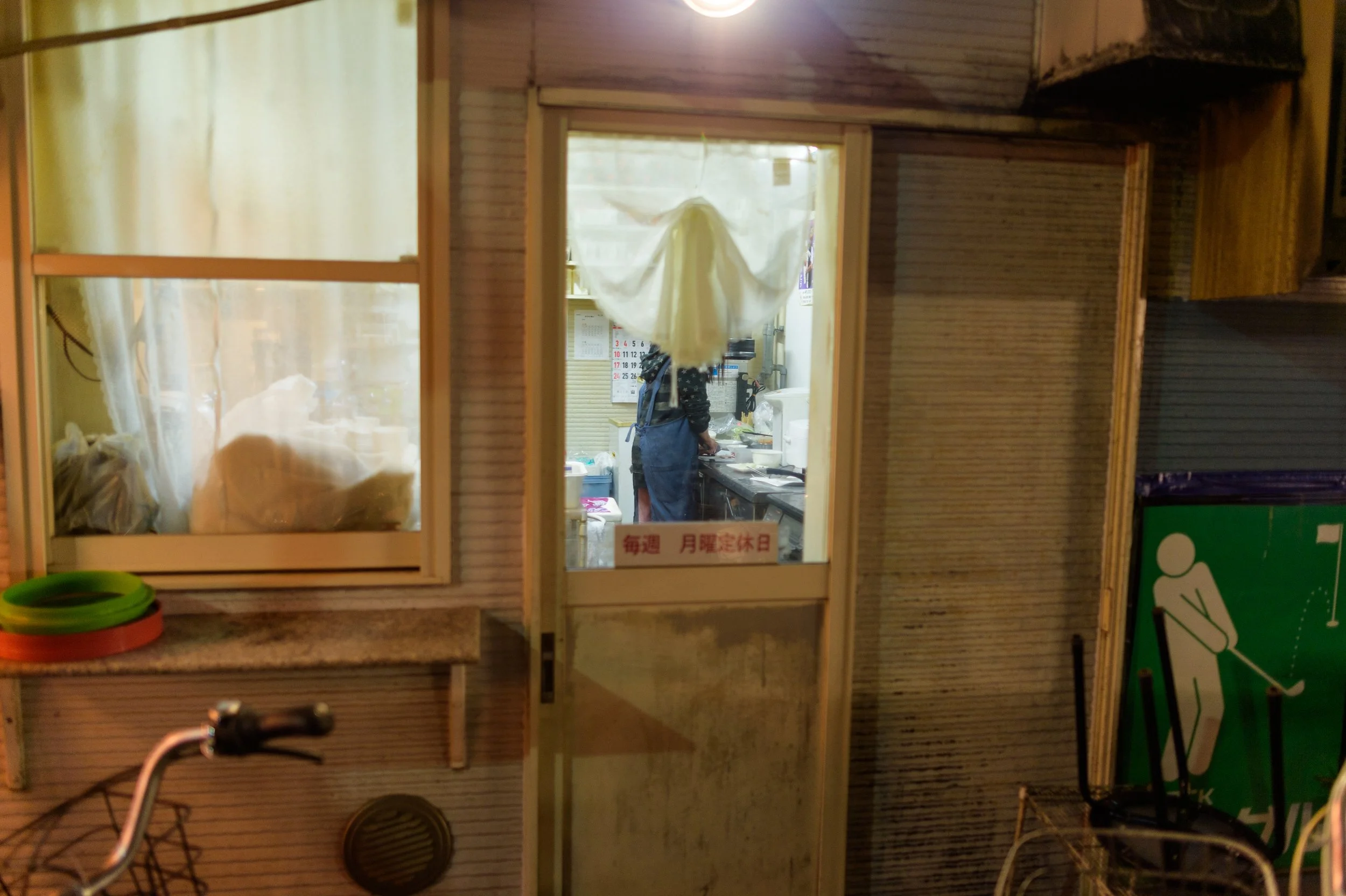
Frame 9: Asakusa, Tokyo. Taken on 28mm #1
Signage obscuring a person's face to give a bit of mystery in the frame. But it's ruined because of that distortion. The door frames, the lines are slanted downwards, giving a sense of “unreality”. It doesn’t feel normal.
You can use that to your advantage to make people feel ill at ease, but, look, the lines looking crooked kind of ruin this frame.
This camera didn't have an electronic level either but I've learned how to keep the camera level without relying on electronics.
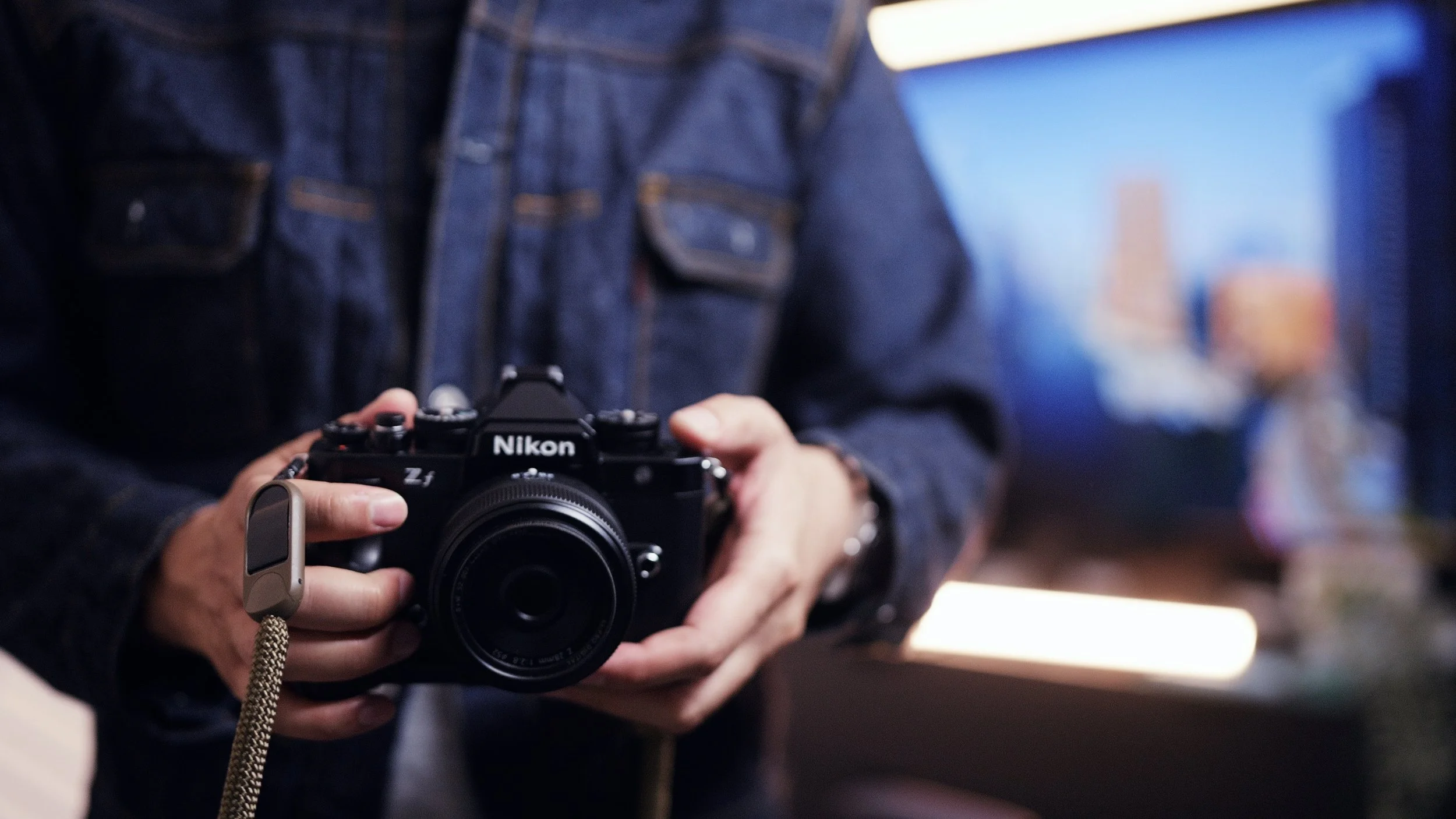
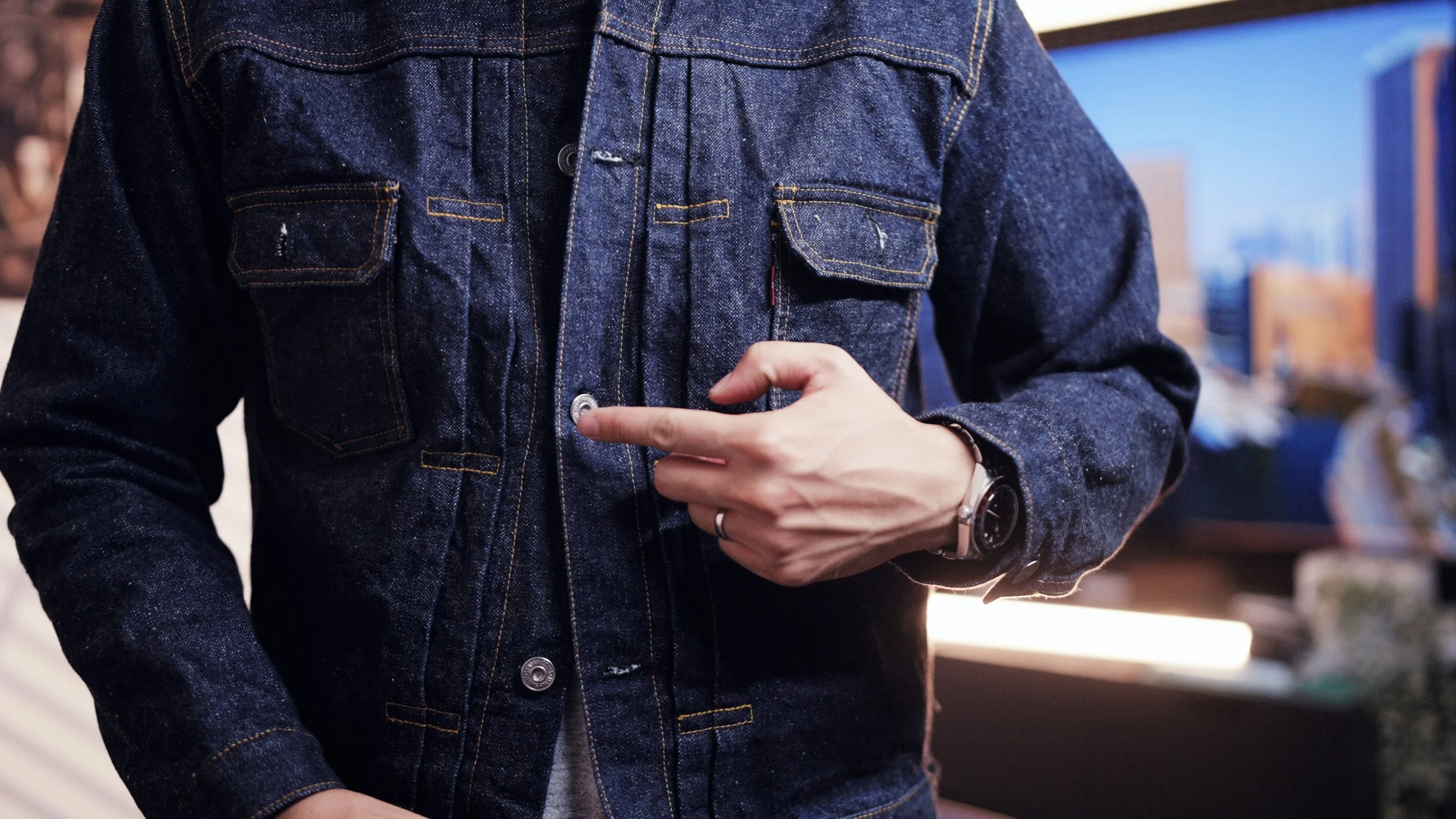
I find a marking on the lens, say a dot or a “Nikkor” label, make sure that’s lined up to a button on my jacket. Even if I'm shooting blind from the hip, the shot's mostly level.
That's how I got this next shot.
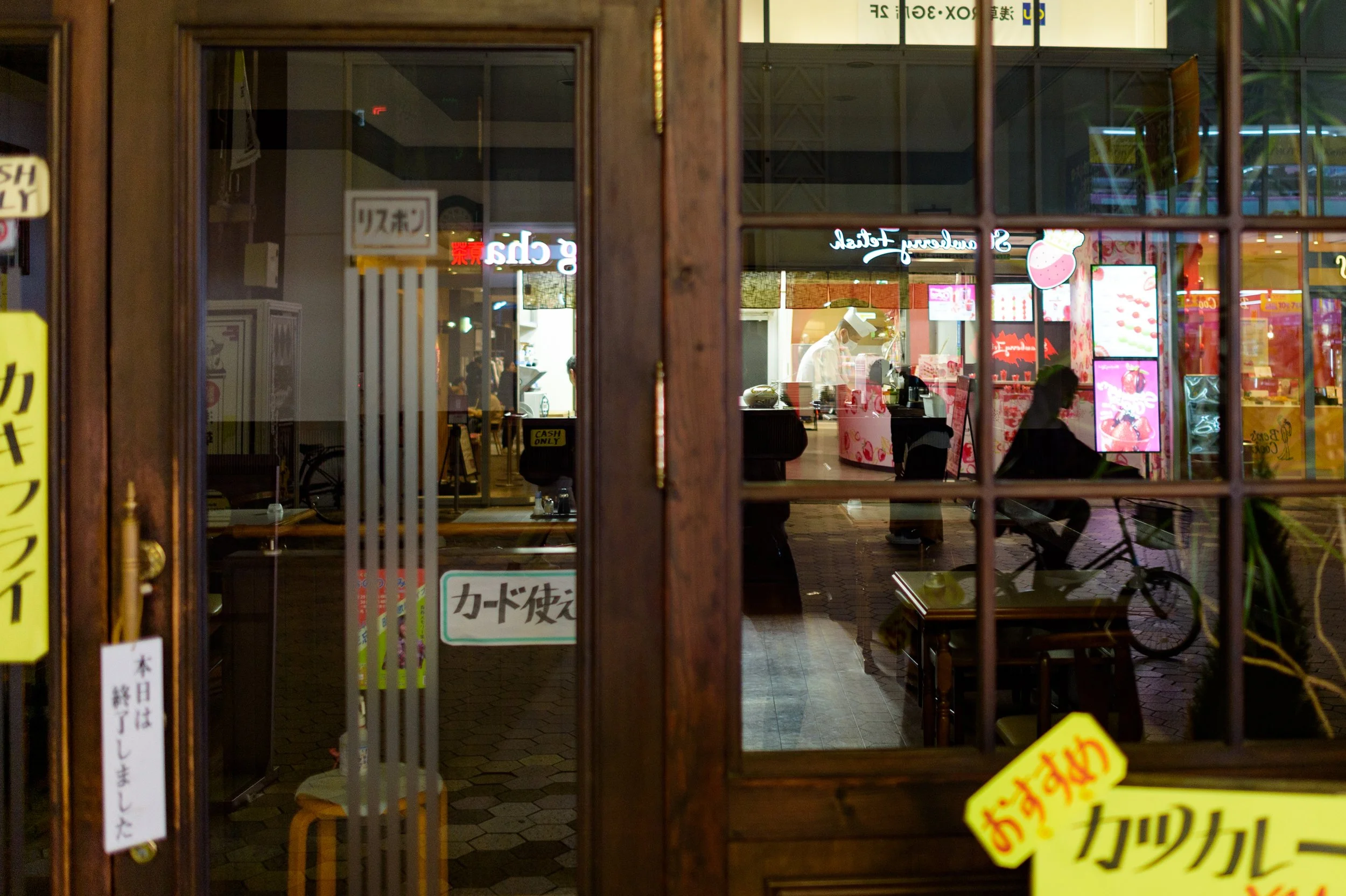
Frame 9: Asakusa, Tokyo. Taken on 28mm #1
This chef in the window was the focal point, but it's also a silhouette of a cyclist. There's analogue and digital signs all across the frame in different colours. These lines look straight.
I was able to fill the frame given that I was in that Goldilocks zone. I was close enough to this window, this silhouette of the cyclist is right there next to me.
What camera lens combo did I use to take these shots?
28mm #1
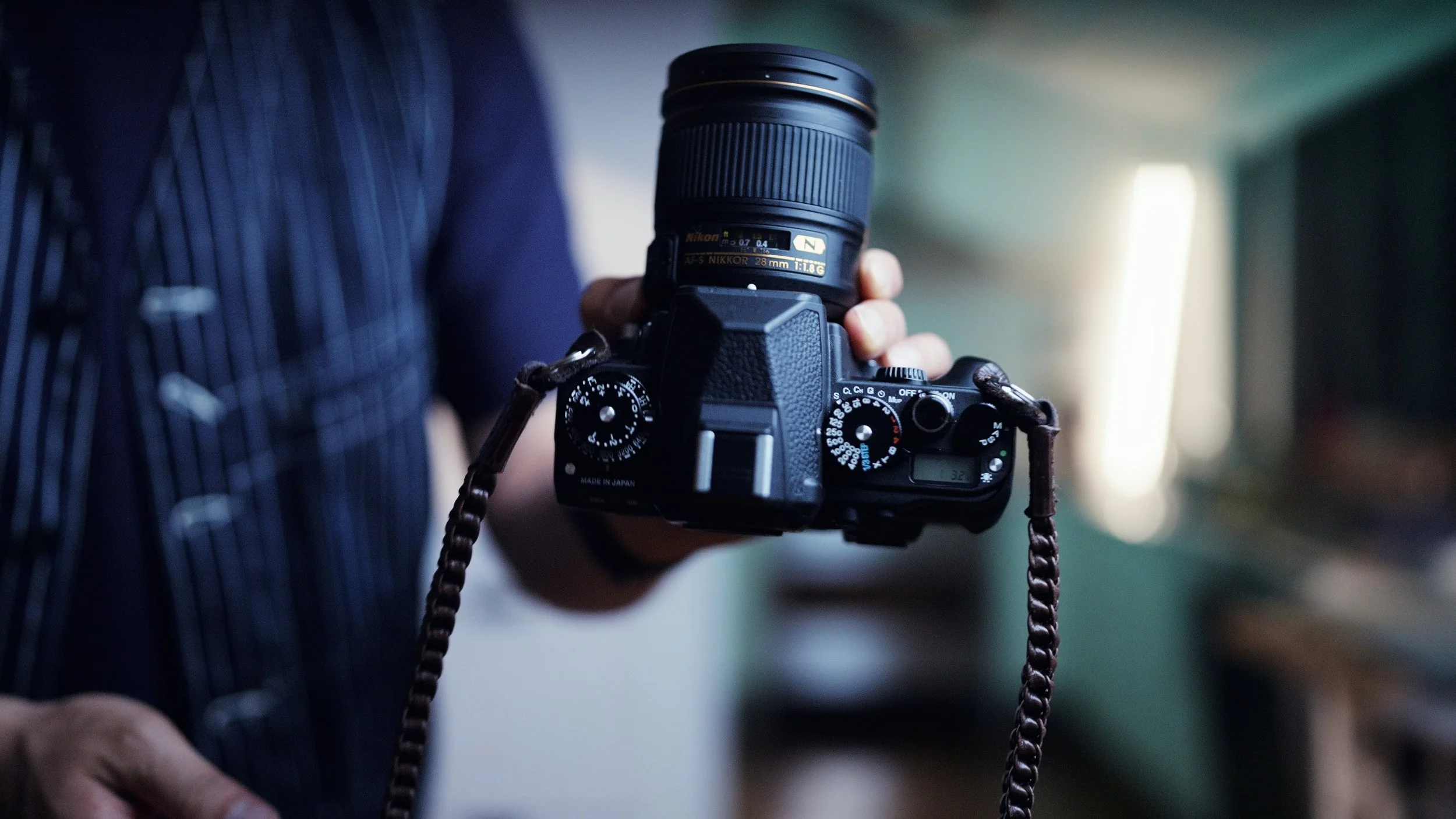
The Nikon 28 mm F1.8 G on F mount on my Nikon DF. It's a great compromise between size and image quality. You can find it for a a few hundred dollars used these days? The auto focus is still fast enough even on the DF's outdated AF module. I'm still waiting for a Z Mount reissue of a faster 28 mm with autofocus, but a 28mm doesn't have to be fast.
Like the old masters, it may be easier to set the scene first on a manual focus lens, fill the frame, get the perfect proportions, then wait for your subject to enter the scene, which is how I got this next shot in Roppongi late at night.
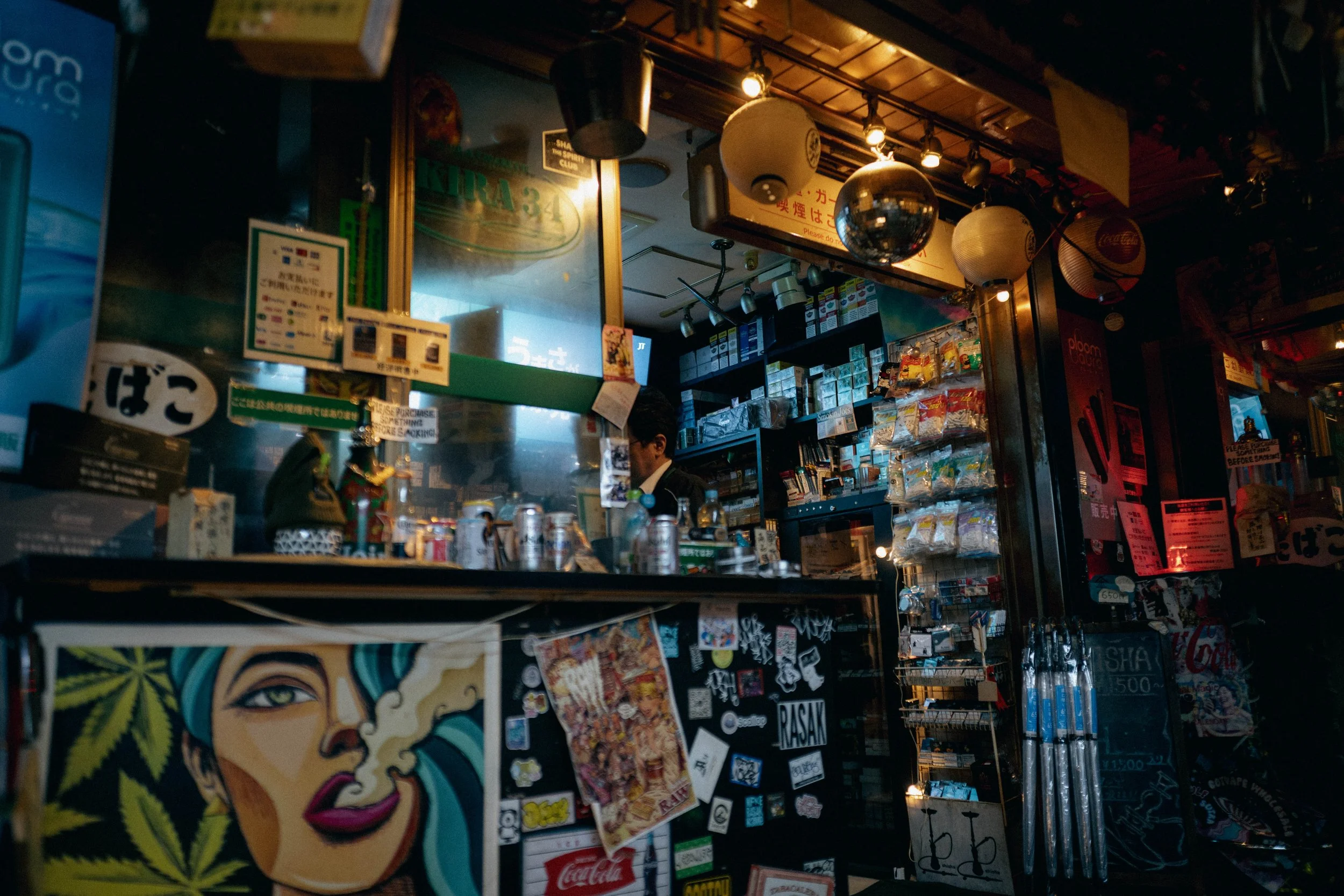
Frame 10: Roppongi, Tokyo. Taken on 28mm #2
This was a grocery store that I walked by, there's a mixture of different coloured graphics, signage, lanterns, ambient blues, reds, oranges, yellows, and greens, all these different colours. There's a hint of a commuter in the middle of the frame.
I was focussing on roughly that spot with a manual focus lens. I got the edges looking right. Not much distortion and the lines look relatively straight? I set the scene before this person even walked into frame because of the manual focus experience.
Even with the ability to pre-frame your scene with a manual focus lens, it's easy to forget that Goldilocks working zone for 28 mm.
That's what happened in the next shot.
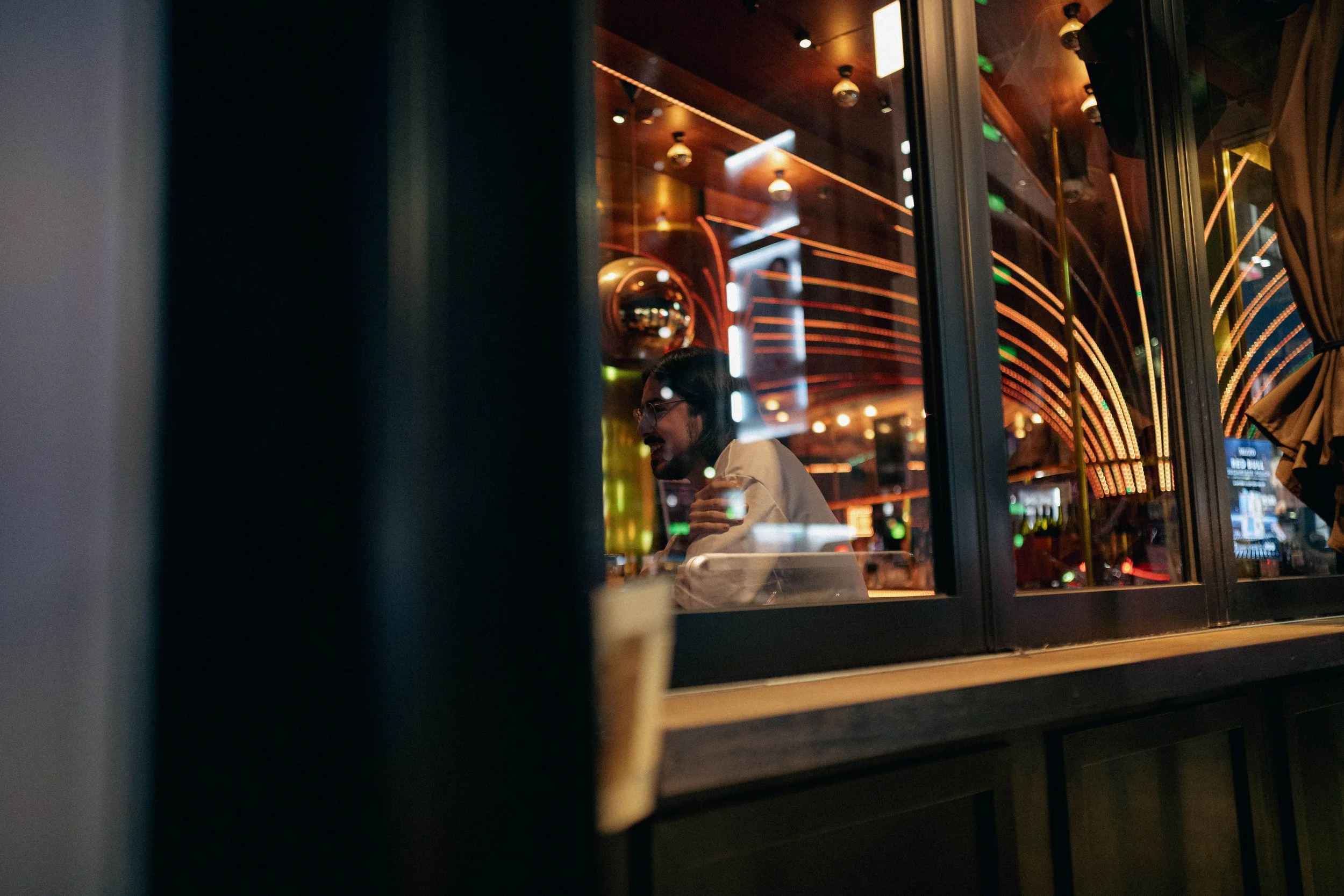
Frame 11: Roppongi, Tokyo. Taken on 28mm #2
I was framing it up for these streaks of light? I really like how they look, and it gave a natural leading line towards the person. But I wasn't as close as I could be.
You can say it's negative space, but really I'm not making good use of it. If I was a little bit closer, I could exaggerate the effects of these leading lines, I'd still get this person in frame.
This is, again, a reminder of how hard it is with 28 mm to get that right working distance, just a little bit closer than an arm's length away.
Another technique that I like to use is reflections. But for 28 mm, I have to evolve on that technique:
IV. Back and Forth Reflections
28mm reflections can look a bit too far away. Especially if you are relying on objects from across the street it is hard to fill the frame completely. You need something in the foreground on your side of the street to anchor the reflection and fill in extra parts of the frame.
Back and forth elements to sandwich the layers in your composition.
It didn't work too well in this next frame:
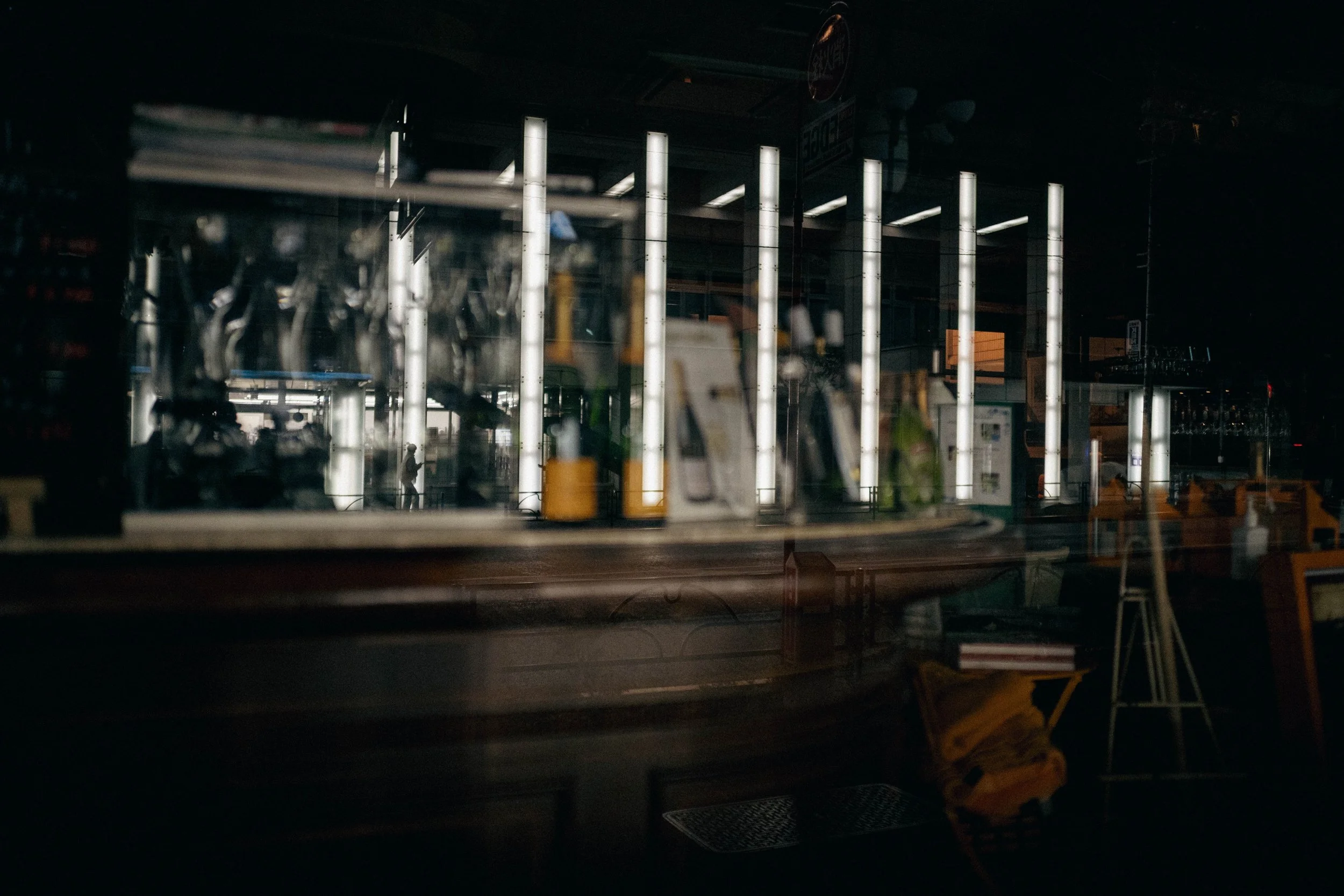
Frame 12: Roppongi, Tokyo. Taken on 28mm #2.
Most of the frame is taken up by what's been reflected from across the street. It would have worked better on a 50mm or 35mm lens. On 28mm there are all of these extra parts of the frame that don’t quite work. The silhouette that I was trying to put next to the column of light is not quite in the right position either.
But it works better in the next shot because I was able to find extra elements in the foreground:
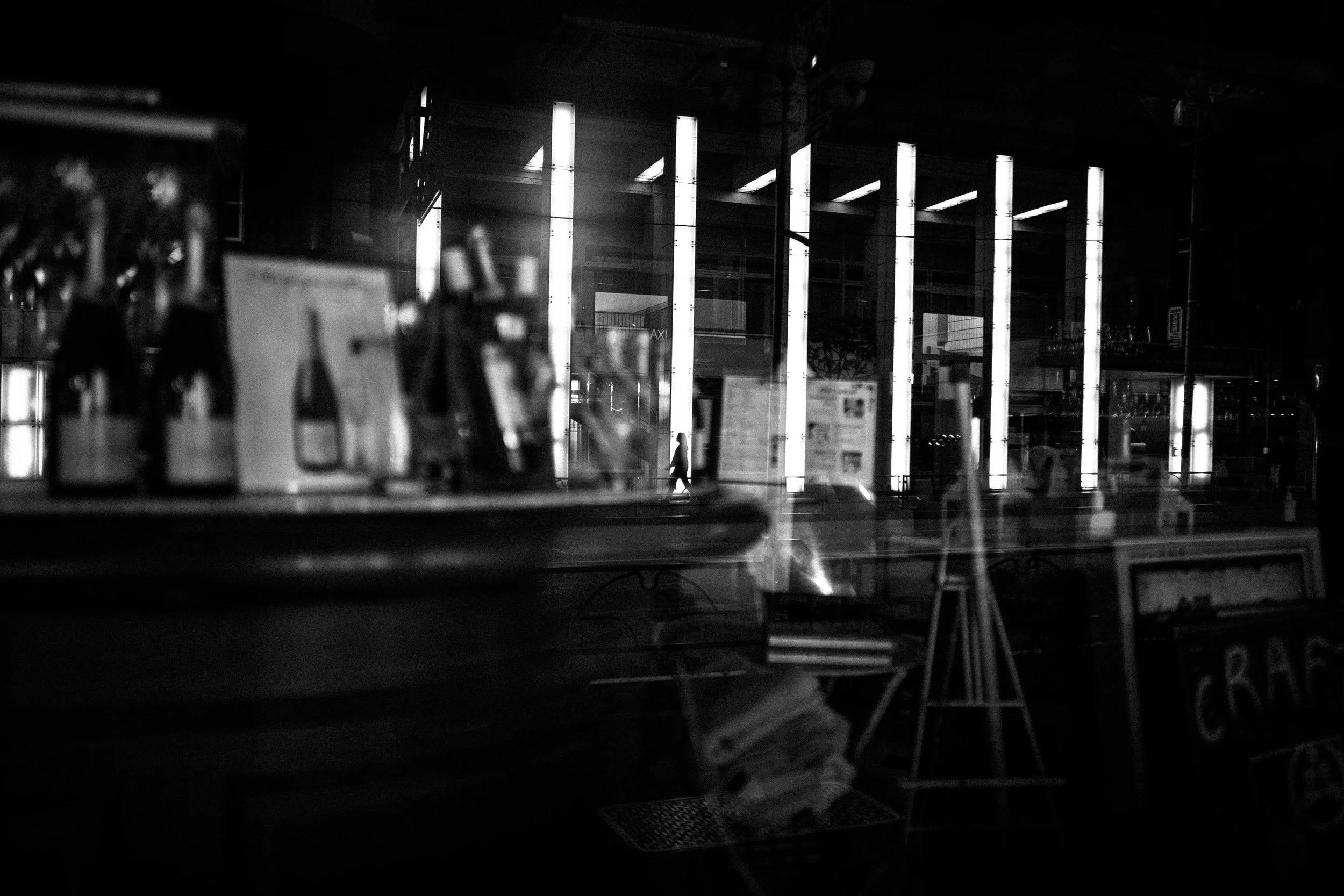
Frame 13: Roppongi, Tokyo. Taken n 28mm #2.
These wine bottles, this table, rest of the signage. This is all sitting just behind the glass on my side of the street that I was getting the reflection off. A neat little slice of the reflection from across the street fit into place. This time, the silhouette in the light columns that are coming from across the street in that reflection? It's in a better central position.
What setup did I use to get these shots in Roppongi, Tokyo at night?
28mm #2
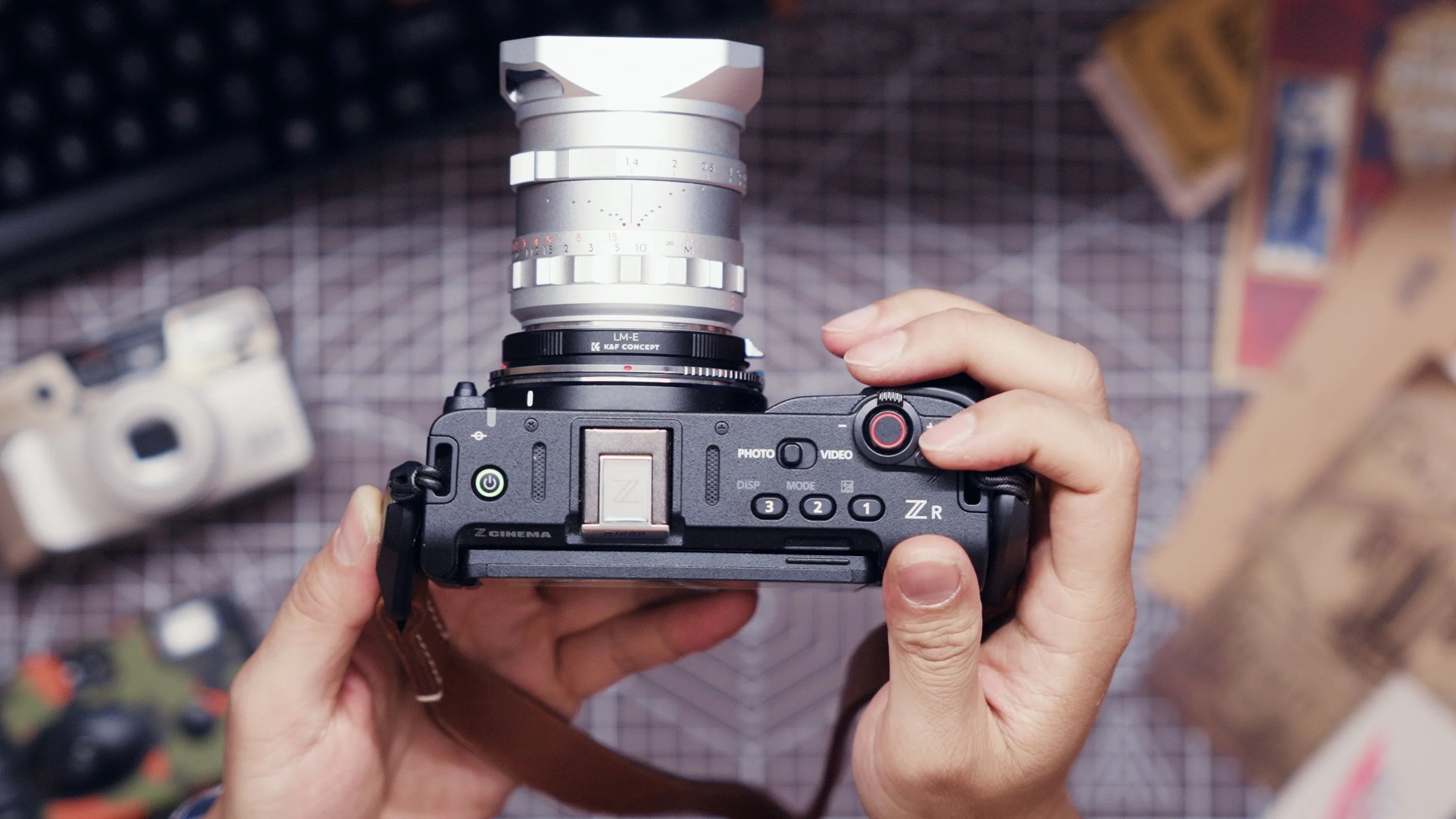
I was using my Nikon ZR, paired with the Thypoch 28mm f1.4 in M mount adapted to the Nikon ZR. I use a double adaptor, the M to E dummy adaptor, and then a Megadap E to Z Pro+ adaptor. I get all the focus assist tools and IBIS. Night time shooting with the faster aperture works well for me too, I have more time to prepare with a faster shutter speed.
What shouldn’t work well? 28mm for hometown photography.
These are scenes I've seen 1000s of times before. nothing stands out as noteworthy? When you're passing these locations every single day on your commute, if I can get 20 a mil working under those circumstances, I'm more confident that I'm getting better at that focal length, which brings me to:
V. Minimalism and Geometry
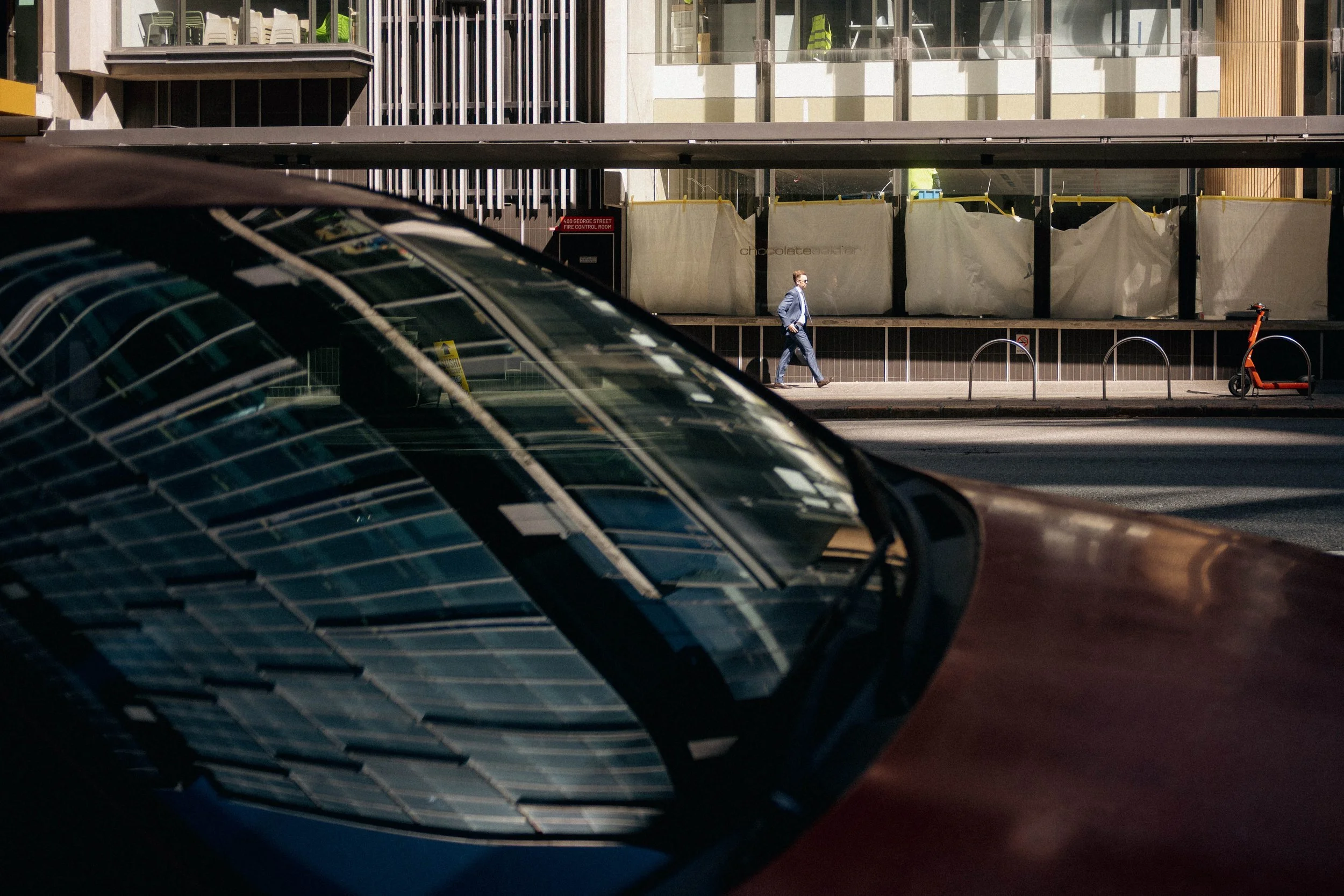
Frame 14: Brisbane, Australia. Taken on 28mm #3.
I really like using car windows as a site for reflection. In this case, 28 mm would naturally exaggerate towards the corners.
There are reflections of the building, and you can see all these lines are adding extra geometry to the scene. The rule of thirds, in this case, draws your attention to this pedestrian who's perfectly in frame, perfectly in stride, clearly not focussing on their facial expression, just there for scale.
They’re an ornament for the space, but really there's not much story.
If you can't get close enough on a 28 mm, my approach is to keep the frame very simple, minimal, and rely on the geometry of a space, rather than the intricacies of a face, you can take a shot from a distance away, you don't have to get so close to people.
But this technique is not without its risks.
28mm #3
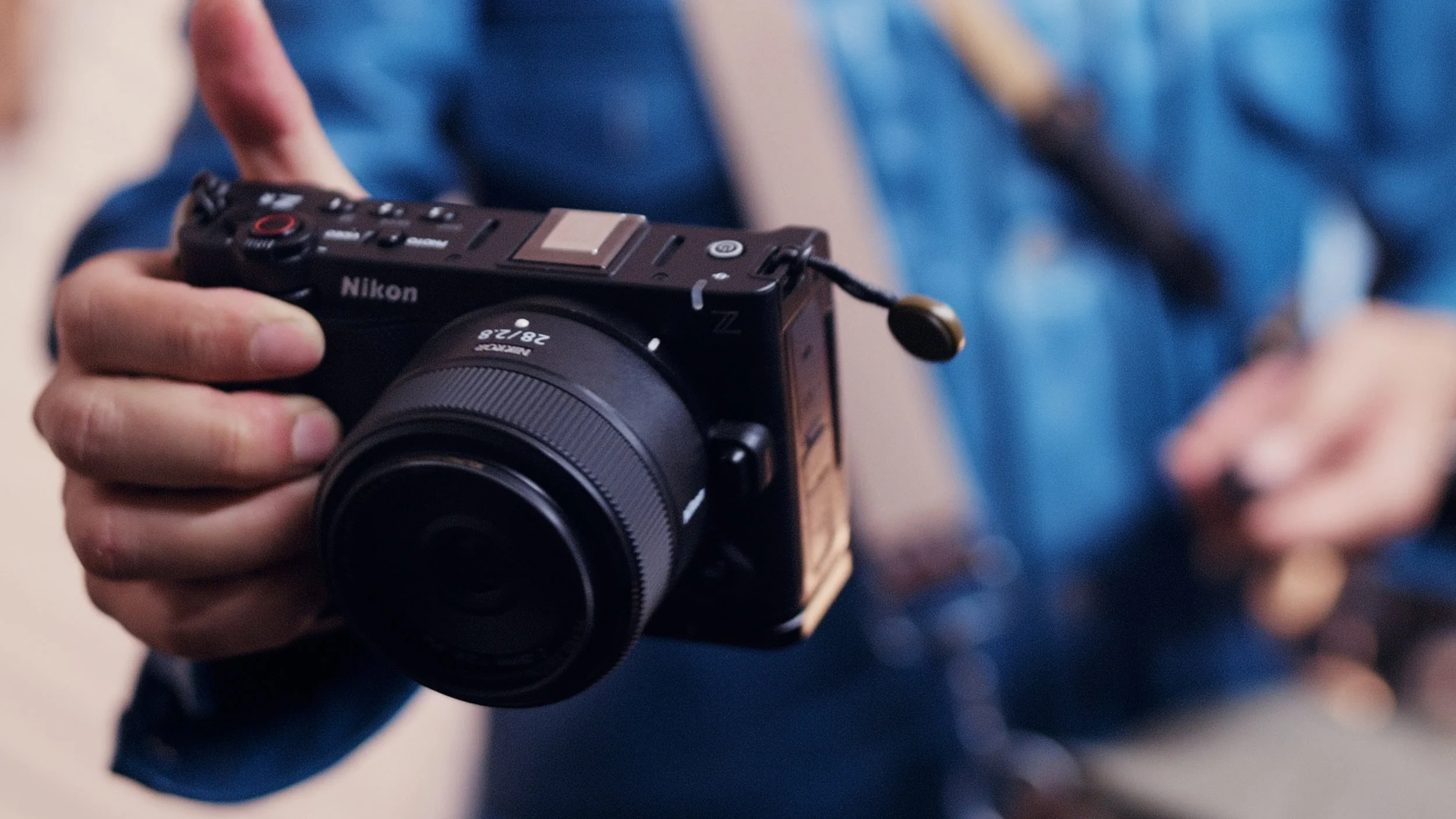
To get these shots in my hometown, I like to use the Nikon 28mm 2.8 Z on my ZR, it is nice and light on a rather boxy, heavy, full frame camera. It doesn't take up too much space in a bag, in and out of the commute every day.
At nighttime, though, I have more time to slow down with a manual focus lens.
This time, it's a Voigtlander:
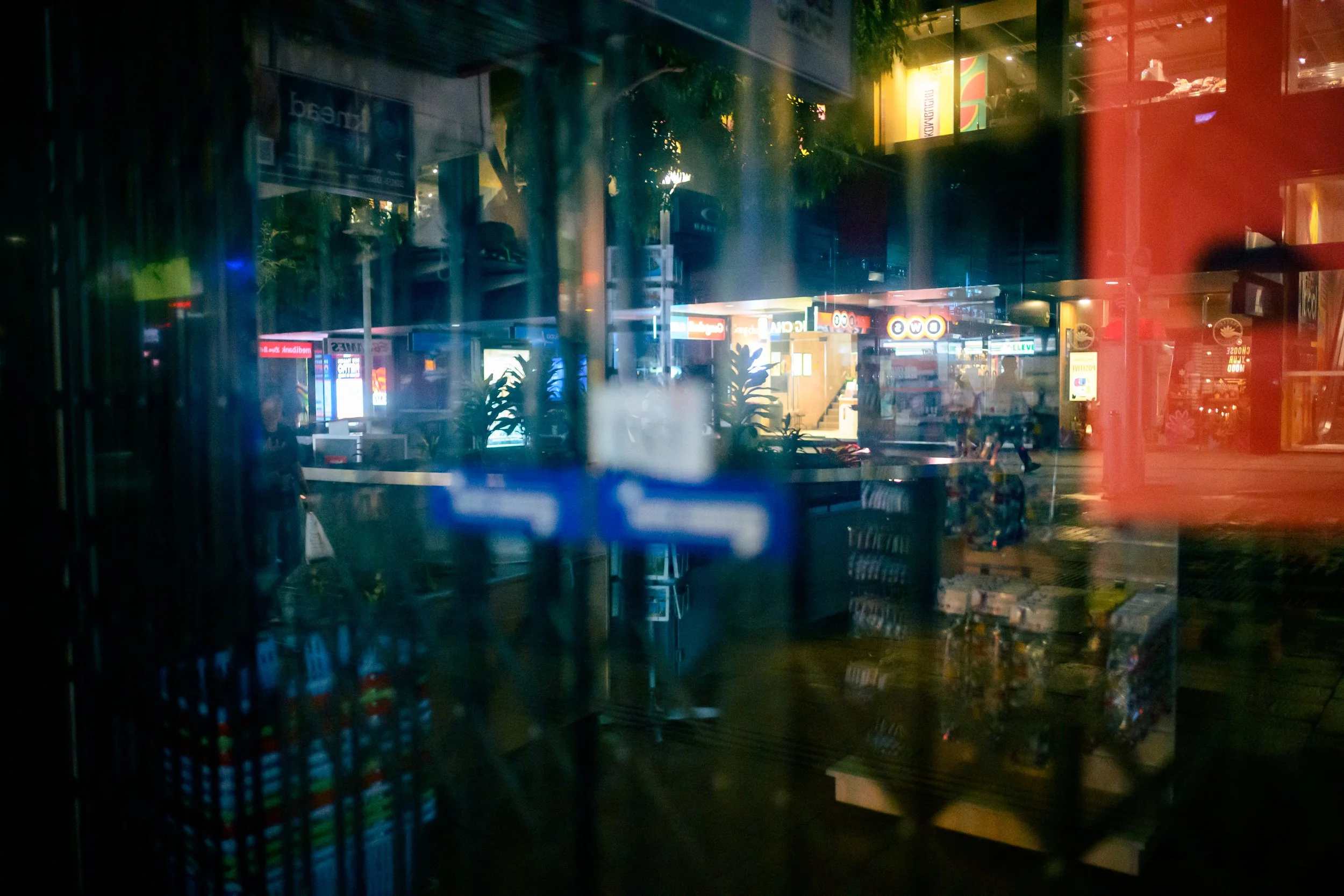
Frame 15: Brisbane, Australia. Taken on 28mm #4.
I'm using that back and forth reflection technique we talked about in Tokyo. These gates, scaffolding bars on the door. This is a reflection of a shop window for a shop that's closed, a bit of extra geometry. Across the street, there are shop windows, a hint of a red sign. There is a silhouette of a person if you look closely, but you know nothing about them.
They're just an ornament of the space.
Multicolour reflections in a late night urban setting.
It's exactly the same reason this next frame uses columns of light, overhead scaffolding, and leading lines.
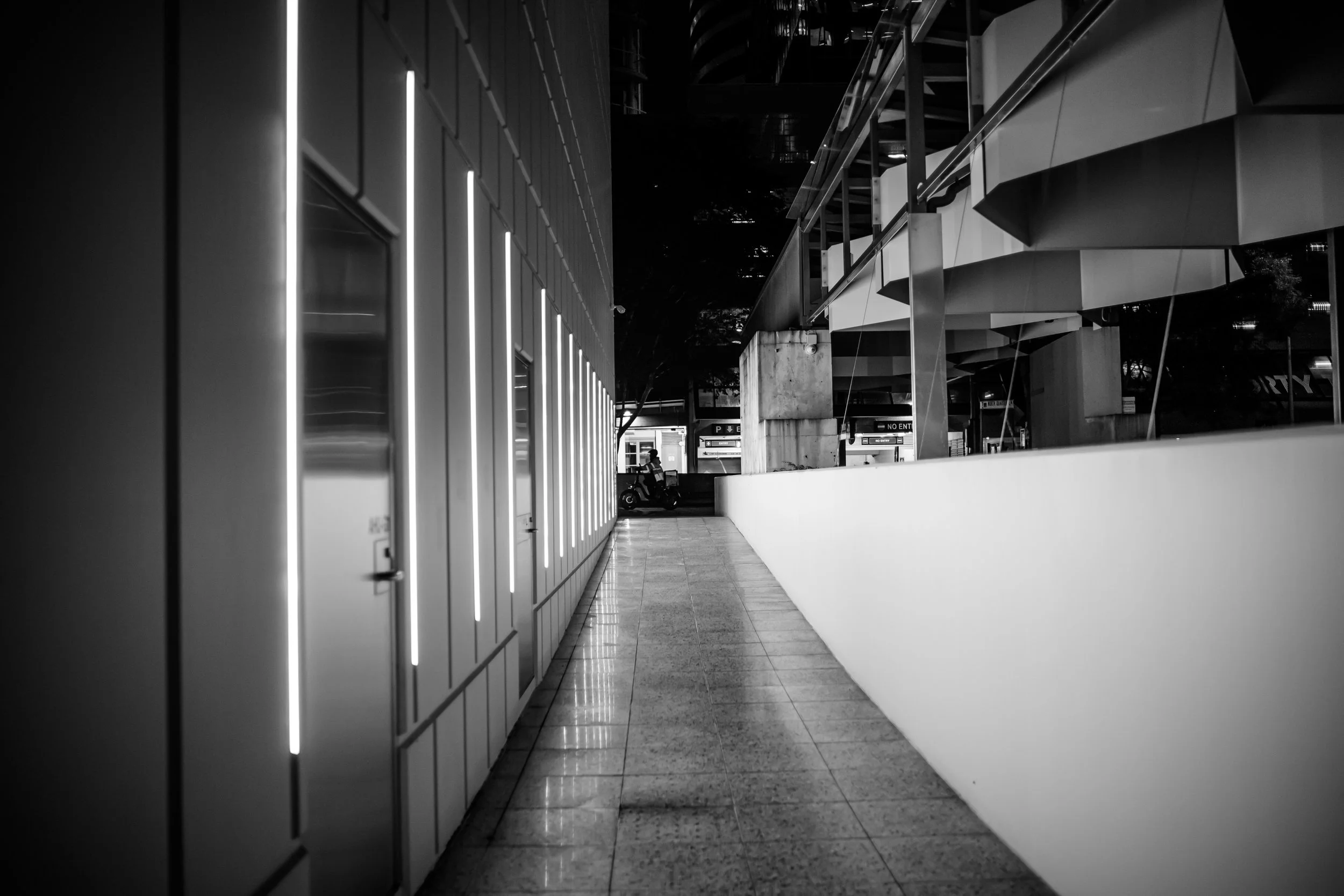
Frame 16, Brisbane, Australia. Taken on 28mm #4
All those visual elements are connecting your line of sight to this pedestrian who is riding a bicycle in the middle of the night (and the frame), for scale.
Maybe it's interesting that they're on a bicycle, but otherwise you don't know anything about them.
I'm using the space, not their face.
The lens I used in this case?
28mm #4
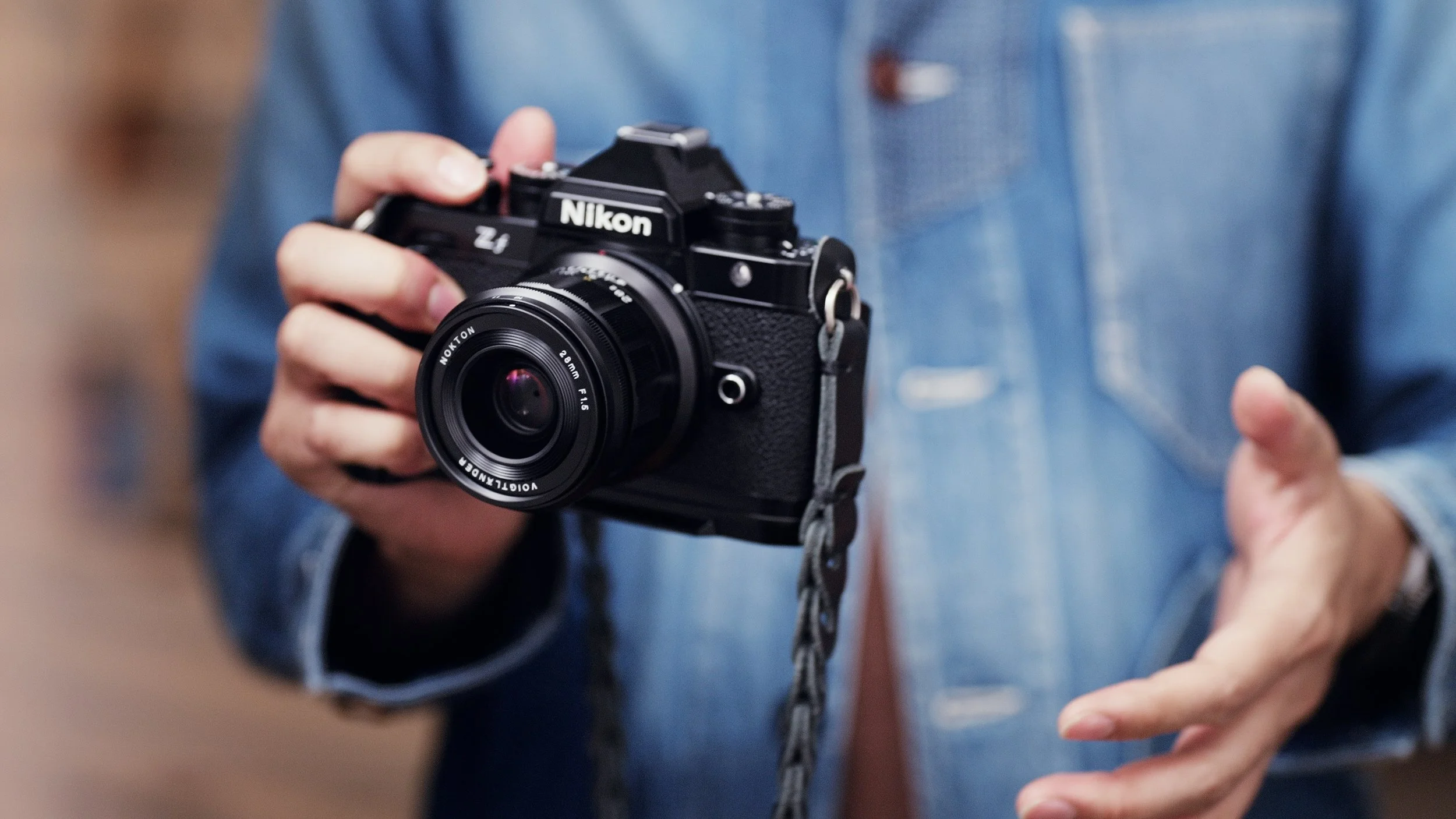
The Voigtlander 28mm f1.5 in Z mount.
Really nice and compact in spite of its speed. It has autofocus assist tools because it's a chipped Z mount lens.
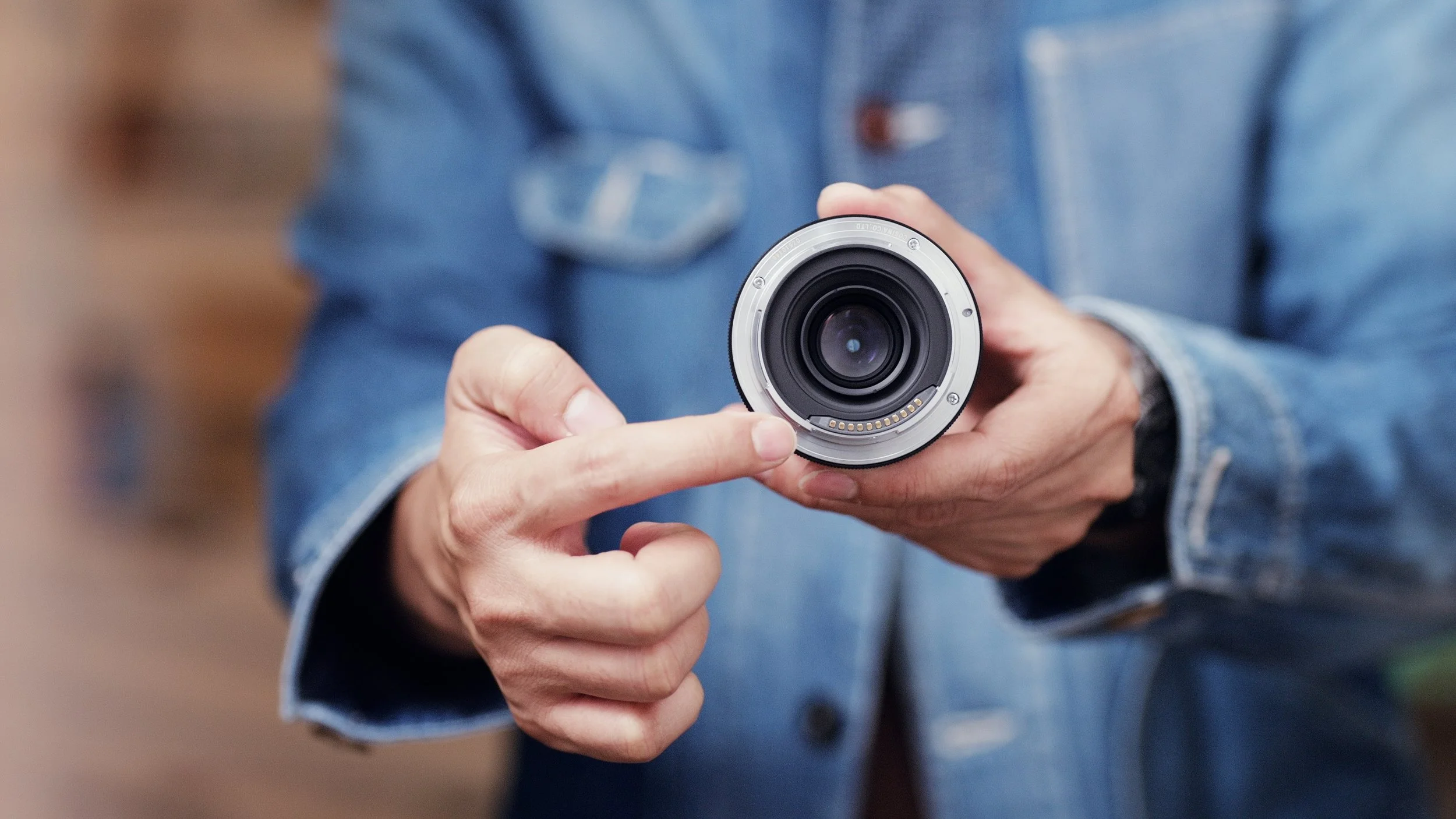
Out of the Voigtlander 28 mm lens lineup, it's not the one I'd recommend anymore though? It used to be the sharpest in the lineup but there was quite a bit of green and purple fringing wide open.
The one I recommend is the Voigtlander 28mm F2 APO - M or Z-mount. It's sharper, better corrected, and about the same size as the F1.5. If you don’t need your lenses to be this sharp then the Thypoch 28mm f1.4 is a good option.
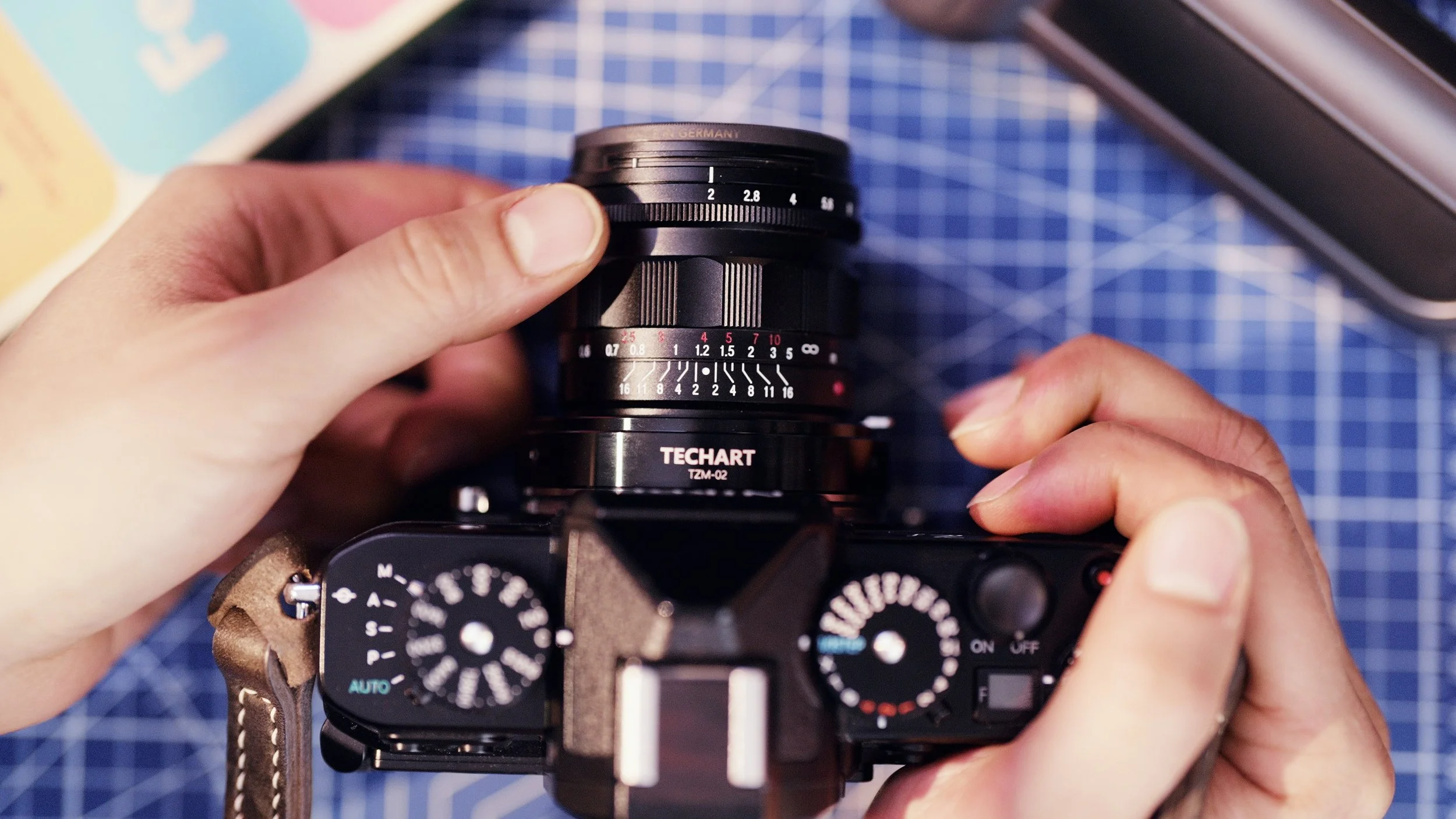
This is 28mm #5. Sample shots: https://jackwang.com.au/blog/travel-combo
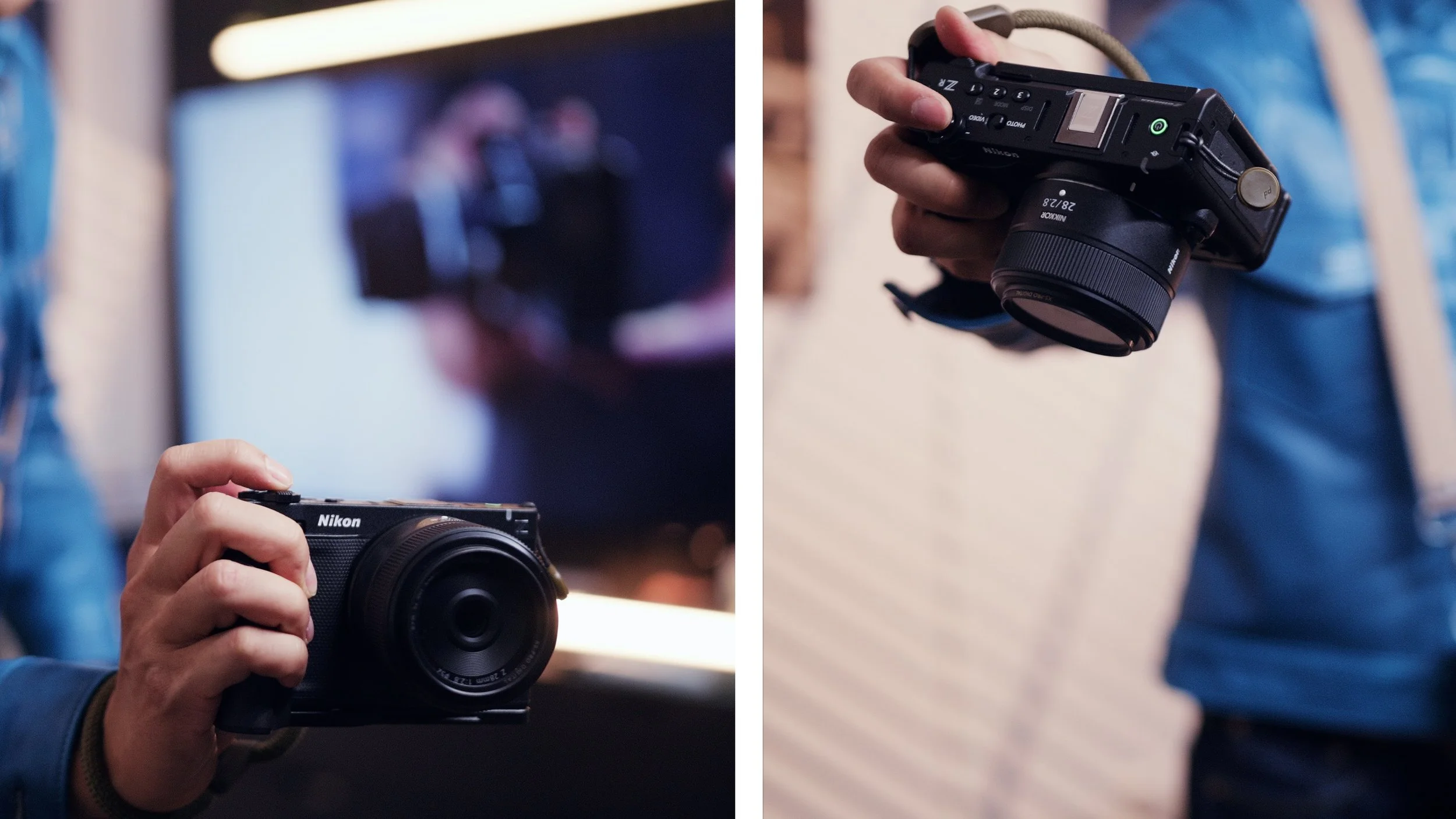
As nice as manual focus is on 28mm, autofocus is very handy to close the distance in a pinch and recompose. On Z-Mount, I'm relying on my 28mm 2.8 Z. It's not the greatest or fastest 28 mm, from 3 metres onwards, even wide open it's very sharp, even though the close-up sharpness isn't that fantastic, and it does have some fringing.
It's just so handy in size, paired with the ZR.
The most impressive autofocus 28mm lens I’ve ever tried however?
It’s not from Nikon.
***
The most memorable 28 mm photos I've taken in the past 5 years are not from Australia, or Japan.
It's a place that's foreign and familiar to me all at once. It was my 1st trip back to where I'm from, Taiwan, in 15 years, and motorbike culture is embedded into that country's daily commute.
Even though I am from Taiwan. I was taken aback, there were so many motorbikes around. I stayed more than an arm's length away.
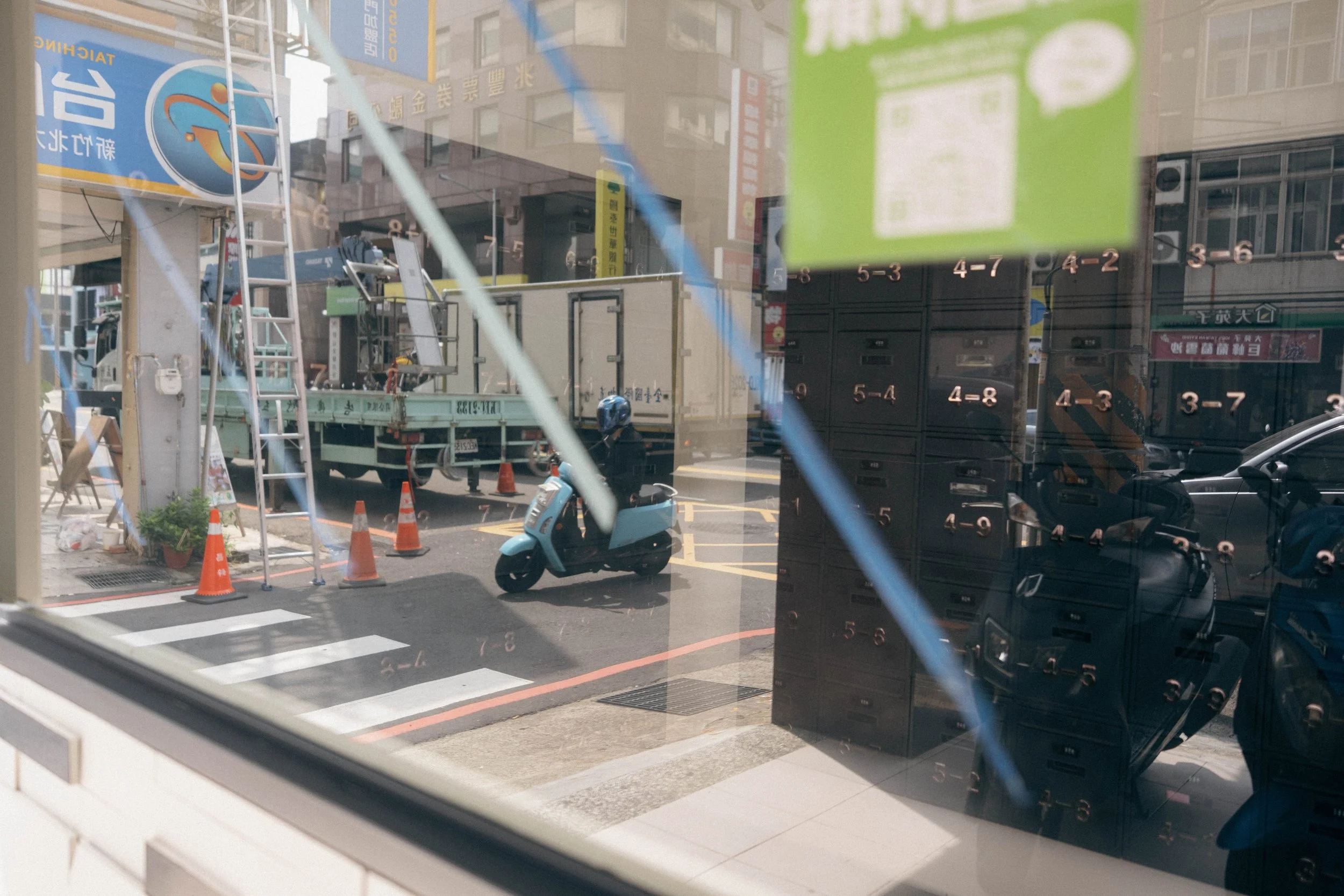
Frame 17: Hsinchu, Taiwan. Taken on 28mm #6
This was taken using the most impressive 28 mm (equivalent) lens I've tested that has auto focus. I was shooting through reflections, trying to get foreground elements, background elements, to get this motorbike in frame.
Still a bit too removed for my faces versus space's dichotomy. For this next frame I got a little bit closer:
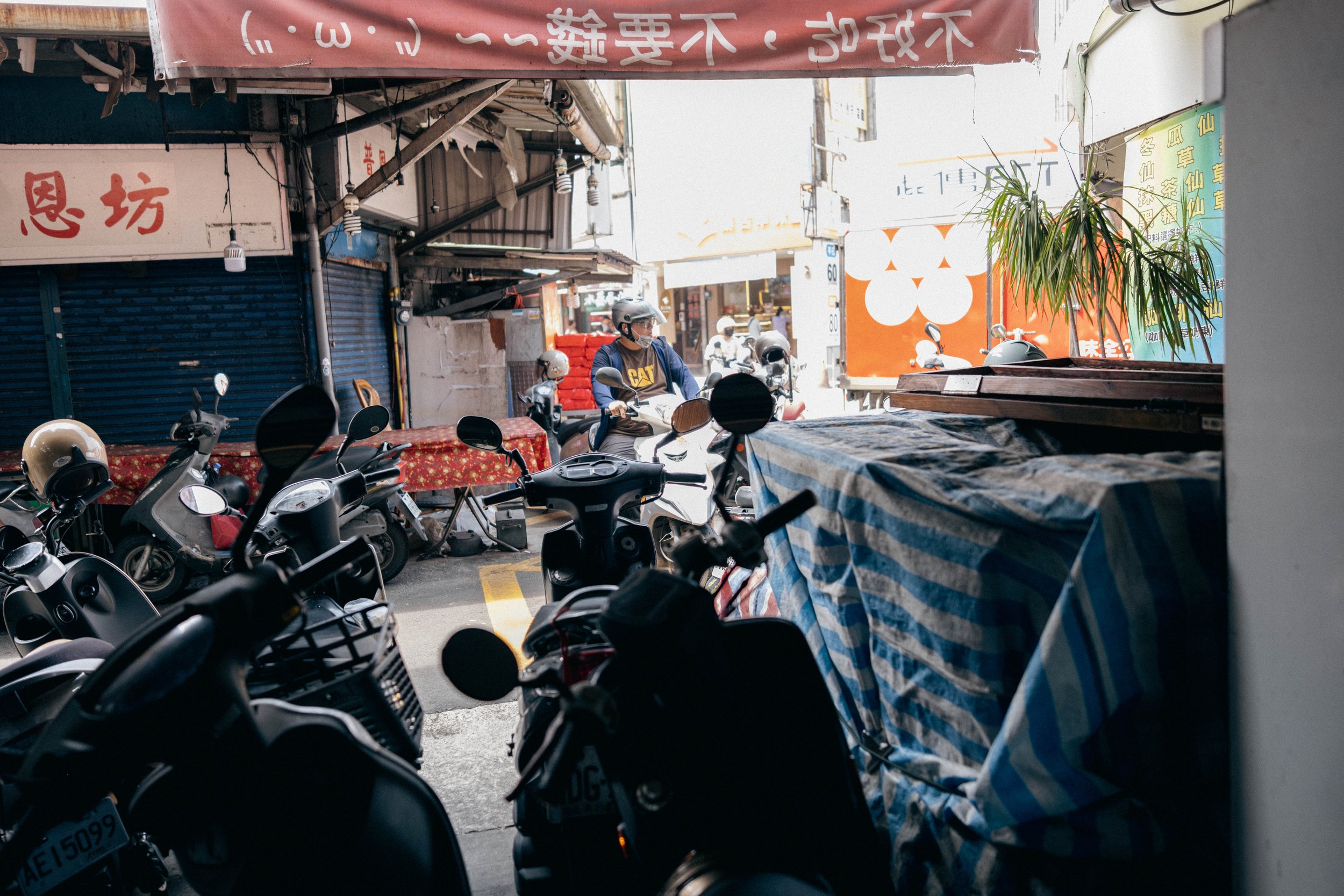
Frame 18: Hsinchu, Taiwan. Taken on 28mm #6.
I was right in the thick of these motor bikes, less than 2 or 3 metres away. I could see their face, at least, and you can get a sense of all the bikes around that space.
And even though on this shot, the motorbike rider was still a little bit further away than I could have been? I did get a face into the shot.
Mine.
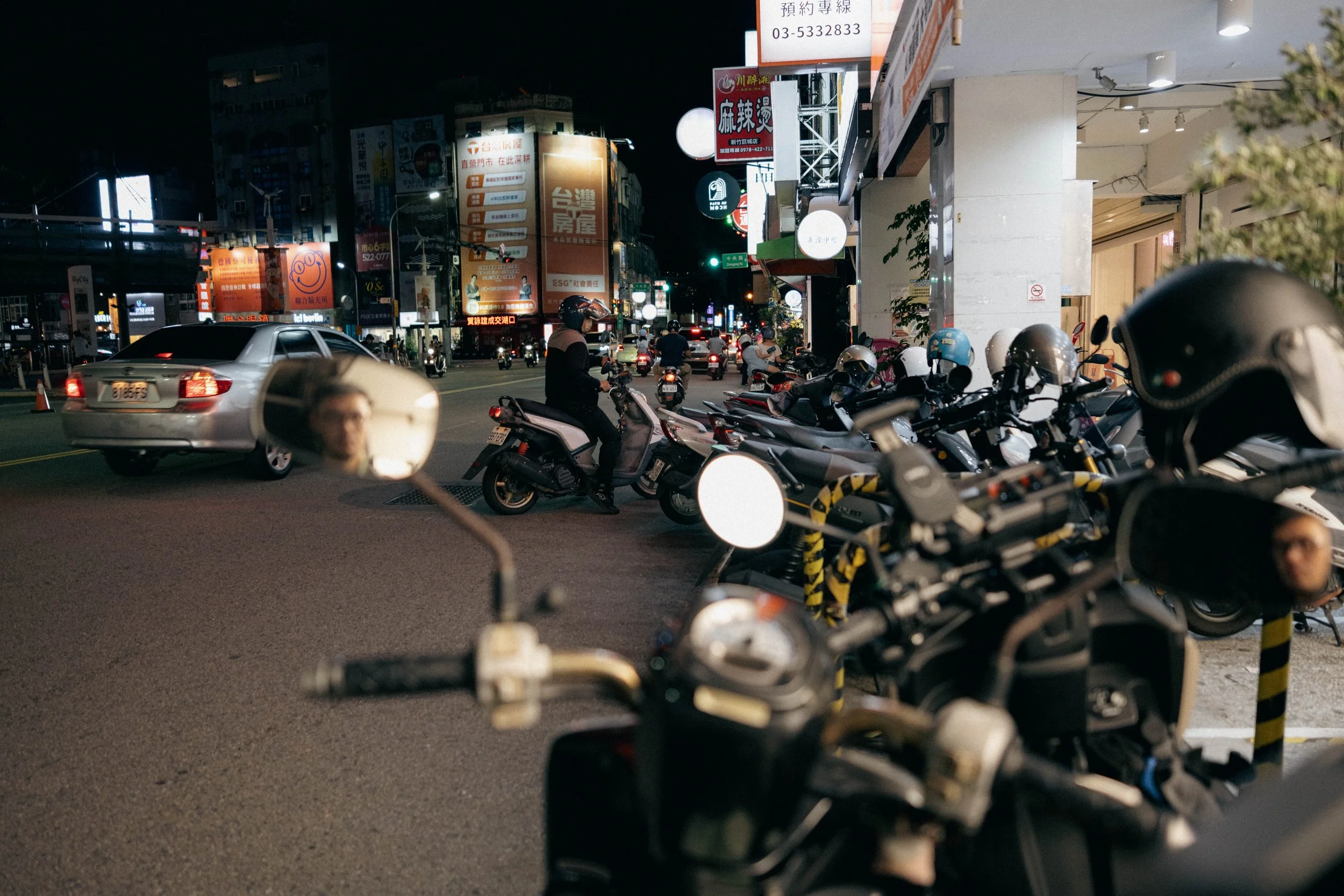
Frame 19: Hsinchu, Taiwan. Taken on 28mm #6
A fish out of water.
Trying to figure out if it's okay to not feel at home.
This photo might not be the greatest 28mm frame, but it's the most memorable to me out of all the 28mm photos I've taken from the past 3 years.
It captured an authentic time in an authentic place.
That delicate dance, the tension in and out of the Goldilocks zone, simultaneously comfortable, and uncomfortable. Is the mystery of 28 mm. When it hits, even it means nothing to anyone else, what you can capture is worth remembering.
These were taken on the best auto focussing 28mm equivalent I've ever tried:
28mm #6
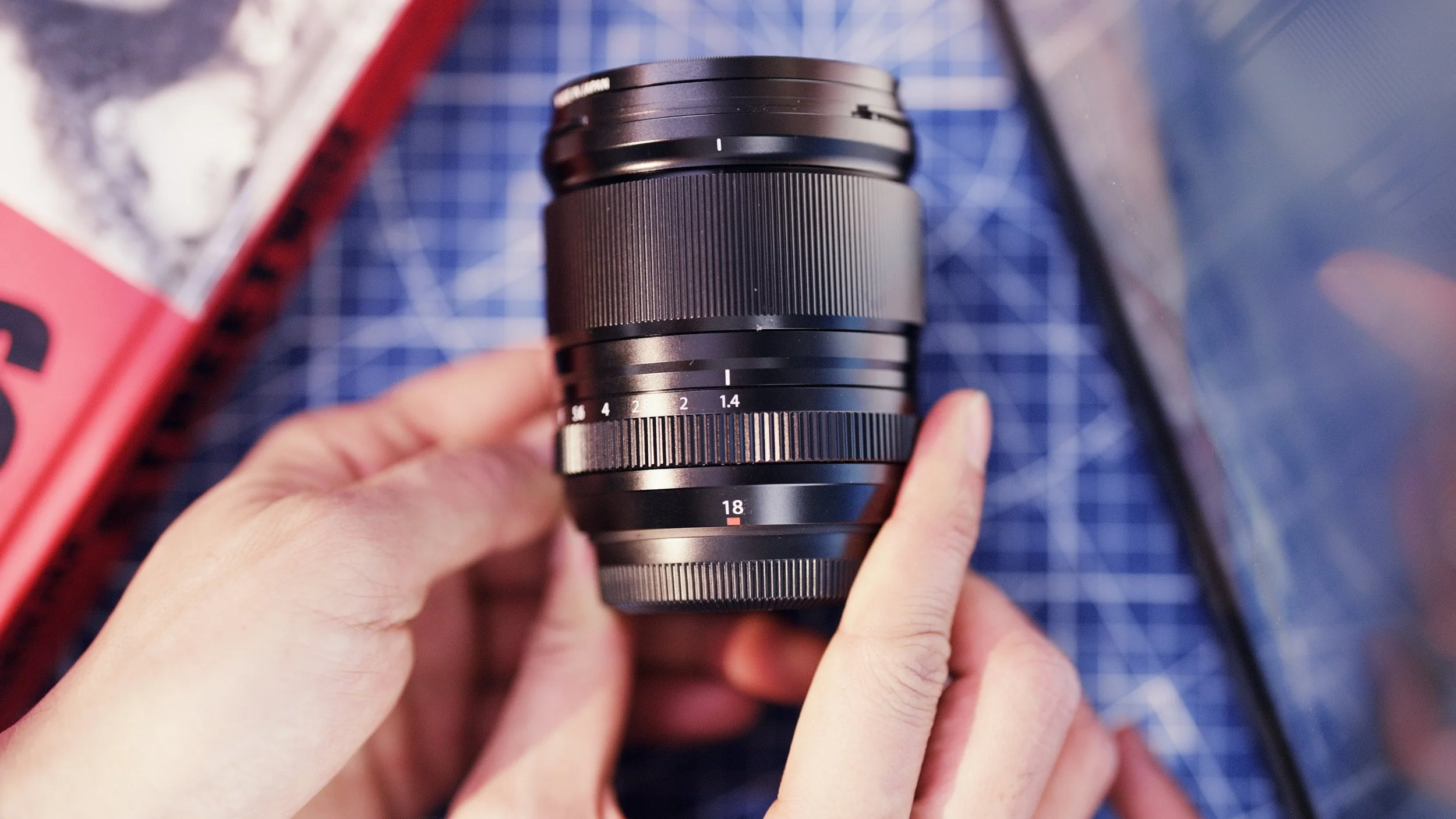
The Fujifilm XF 18mm f1.4, but it’s not in my kit anymore.
I've sold it along with all my other Fujifilm gear in an attempt to downsize. More on my current kit in the next post.
If you'd like to share your 28mm photos with me and this community (>20K YouTube, 1K newsletter)?
Fill in the form below:
Let me know if you like this new Lens Lab series?
Jack.
All my sample images in this blog post were edited from RAW files using my free Chrome emulation preset. They work with most RAW files from different cameras as long as you use “Adobe Color” as the starting base. Download it for free here.
If you’d like to support my work please consider purchasing gear through my affiliate links:
Nikon 28mm f1.8 G: https://geni.us/I6waxBt
Thypoch 28mm f1.4: https://geni.us/zjPaLdn
Nikon 28mm f2.8: https://geni.us/tyZX2A
Voigtlander 28mm f1.5: https://geni.us/bcFIlN
Voigtlander 28mm f2 APO: https://geni.us/voigtlander28mmAPO
Fujifilm 18m f1.4: https://geni.us/WPLEZww
Nikon ZR: https://geni.us/KH4uMvX
ZR wooden grip: https://geni.us/ZR-wood-grip
Wotancraft 10L Messenger bag: https://geni.us/wotancraft-salt-pepper
Wotancraft leather strap: https://geni.us/wotancraft-leather-st